Introduction of Mana Village
Mana village, well known as the "first village of India", is located at an altitude of
10500 feet (3200 meters
) above sea level in Chamoli district of Uttarakhand. It is the last settlement from the Indian side near the India-Tibet border, so formally it was also known as the "Last Village of India".
This village is just at a distance of 3 Kms from the
Badrinath temple
and is the only village where the river Saraswati can be seen.
In addition to the geographical and tourism importance, this village is also well known for having a deeper connection to Indian history and especially with the Mahabharata age. Some of the key attractions around the Mana village are Vyas Gufa, Ganesh Gufa, Bheem Pul, Saraswati River,
Vasudhara Fall
and many more.
In our
Char Dham yatra packages
and
Do Dham yatra package
, Mana village is a mandatory sighting, as the pilgrims love to experience the untouched beauty of the Himalayan ranges and feel the taste of tea at the shop of the first village of India. Most of the devotees also love to stroll around the streets and enjoy the Tibetan culture.
Location:
Chamoli district, Uttarakhand, India
Height:
3,200 meters or 10,500 feet
temperature
: 3° to 11°C
Best time
to visit Mana Village: May to October
Nearest Railway Station
: Haridwar
Nearest Airport: Jolly Grant Airport, Dehradun
Mobile Connectivity
: 4G networks are available.
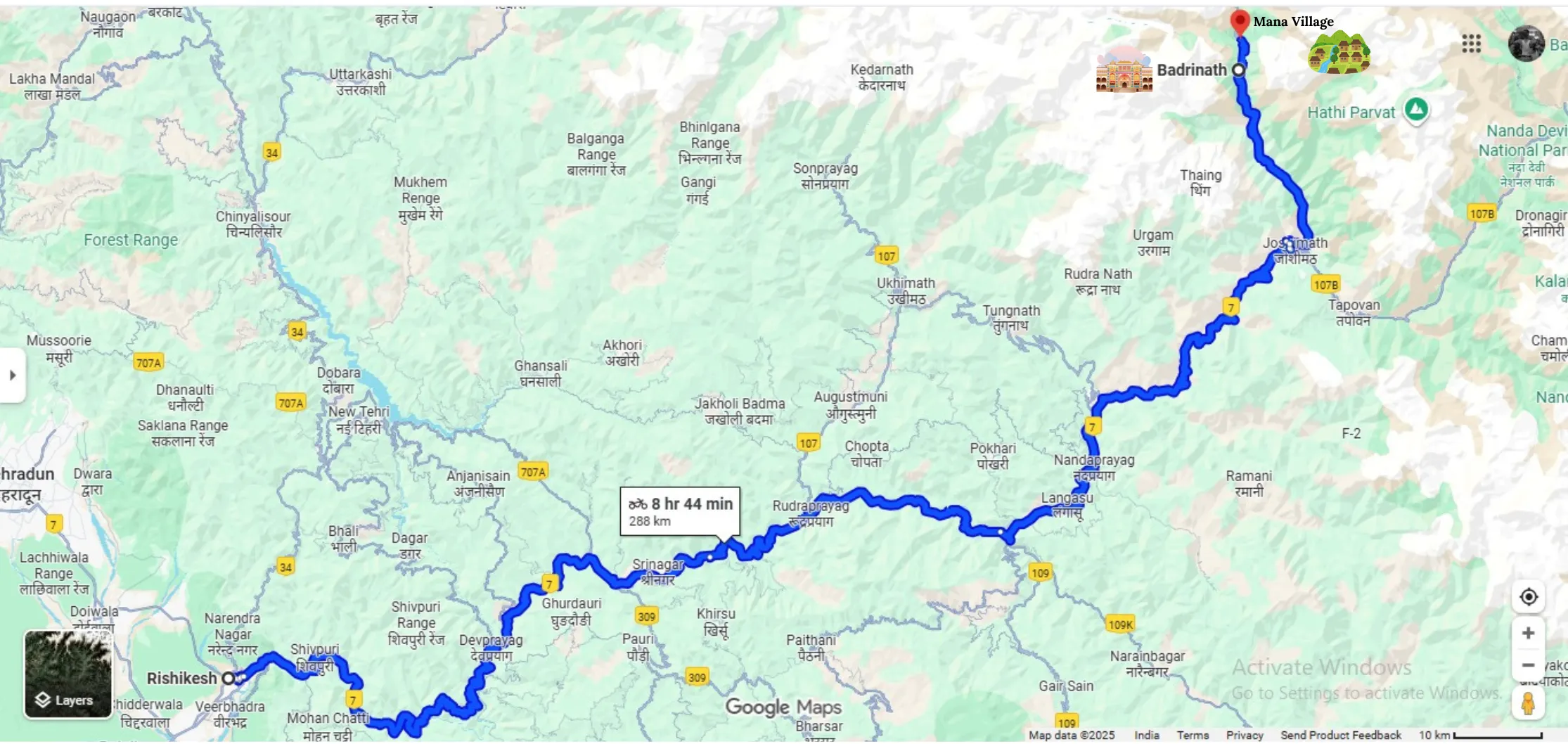
Where Is Mana Village?
Location & Map:
Mana village is located in the Chamoli district of Uttarakhand near the Indo-Tibetan Border, and it is surrounded by snow-capped Himalayan peaks, offering scenic views, making it a popular spot for nature lovers or trekkers.
Height:
The village is situated on the banks of the Saraswati River at an altitude of 10,561 feet(3,219 meters) above sea level.
Interesting Facts About Mana Village
-Mana Village is located near Badrinath Temple and holds great cultural, spiritual, and geographical importance.
-The Saraswati River is visible only in this village.
-Keshav Prayag, the confluence of the Alaknanda and Saraswati rivers, is located nearby.
-The locals mainly belong to the Bhotia (Marchha and Jad) tribes and follow Tibetan culture.
-It was renamed from the “Last Village of India” to the “First Village of India” in April 2023.
-The rebranding followed PM Narendra Modi’s visit on 21st October 2022, emphasising its strategic and national importance.
-The village offers stunning Himalayan valley views and serves as the gateway to Vasudhara Falls and Satopanth Glacier treks.
-Mana is also famous for its rare stones, kidney beans, potatoes, and medicinal herbs.
-The village combines natural beauty, cultural heritage, and spiritual serenity, making it a must-visit destination.
History & Mythology
Mana village has a glorious history and mythology. This village also has a deep connection with the Mahabharata. The key mythological sites, which tell a unique story about this place, are the Vyas Gufa, Ganesh Gufa, Bheema Pul, and Charan Paduka (footprints of lord vishnu). Let’s discuss each site and its historical importance one by one in detail.
Mahabharata’s composition
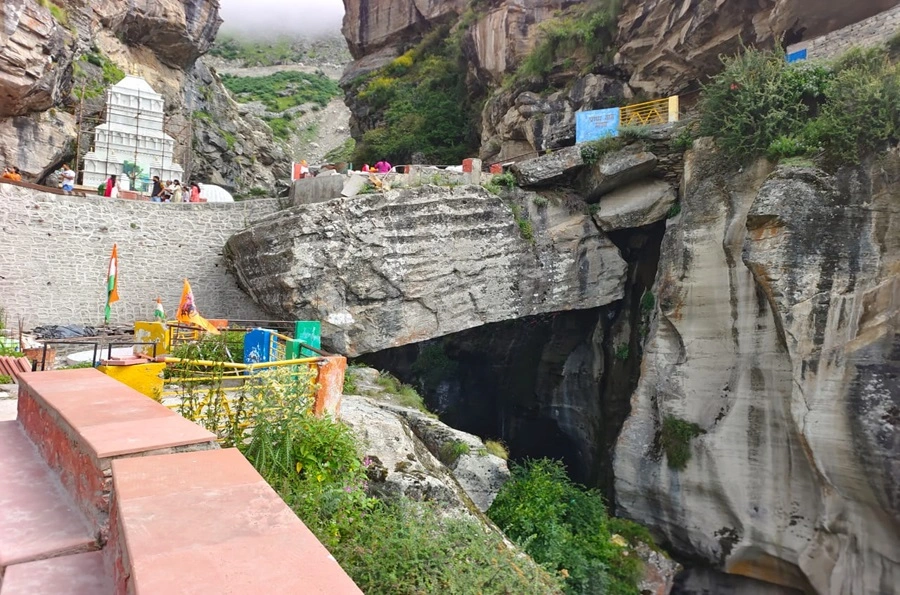
: According to the legend, the epic Mahabharata was composed by Sage Ved Vyasa at Vyas Gufa, and Lord Ganesha transcribed it at Ganesh Gufa. Both Ganesh Gufa and Vyas Gufa are located at just distance of just 250 meters from each other and in the northern part of Mana village.
The final ascent of the Pandavas' heaven journey
: According to the historical scriptures and Hindu mythology, it is believed that the Pandavas, with their wife Draupadi, after renouncing their kingdom, went towards the Himalayas. Passed through this village on their journey to heaven (Swargrohini Yatra). Now, many devotees also believe that the way to heaven goes through this village.
Charanpaduka:
A sacred rock with the foothills of lord vishnu near the village, adding another spiritual significance.
The Tale of the Pandavas to Heaven:
After a difficult climb of 35 km from here, there is a mountain known as Swargarohini. According to the story shared by the locals, the Pandavas took the way from Mana village to reach heaven through Swargarohini, although during the journey, only Yudhisthira and one dog accompanying him were alive; Draupadi and the other Pandavas died on the way.
According to the Mahabharata, all the places on the way to Swargarohini Mountain are known by the same names. It is also prevalent that a dog was walking with Yudhisthira and reached the mountain with him, and they both reached heaven together. Hence, the journey to heaven started in Mana village and it is also known as the gateway to heaven.
Pandavas are going to heaven through Mana village after visiting Badrinath Temple
A tale behind the Caves in Mana village
In addition, the famous caves of Mana village, known as Ganesh gufa and Vyas gufa, are prominent among the visitors and have an amazing history behind them, which says that the saint Vedvyas wrote the epic of Mahabharata in this village, and Lord Ganesha wrote the verses of Ved Vyasa in the caves of this village. Local people claim that Maharishi Ved Vyasa created the Vedas and Puranas in the village of Mana, and consequently, these places are known as Vyas Gufa and Ganesh Gufa, respectively.
The tale behind the Blind Corner of the Saraswati River
A beautiful tributary of the mighty Alaknanda River, Saraswati has attractive views, and its tale justifies the blind corner of its boundary. A very famous tale of lord Ganesh associated with Saraswati river is prevalent around Mana village which says, Once when lord Ganesh was writing the verses narrating by ved Vedas then the fast flowing river Saraswati was flowing with its full speed making noise and disturbing lord Ganesh in writing, then lord Ganesh asked goddess Saraswati to flow reliably keeping silence but she ignored his saying and consequently, lord Ganesh cursed her that the river Saraswati won't be visible after a certain length and it happened so and likewise the river flows invisibly after a certain distance, although the river flows roaring around the Bheem Pul yet.
The tale about the Bheem Pul
Another story associated with the Saraswati River says that Bheem, the second oldest of the Pandavas, is said to have built the Bheem pul, a stone bridge in the city to cross the Saraswati River. And this happened when the Pandavas were passing from there. To cross this river, Bheem put a big rock on it, which is now known as a bridge called Bheem Pul. The bridge stands on a single rock, so locals believe that the footprints near the stone bridge belong to the legend of Bheem.
A Folk Tale of "Curse-Free Mana"
Legend says that this village is a "village without a curse," blessed by its creator, Lord Shiva. There is a fable that says anyone who sets foot in this land will become rich overnight. A supporting story tells the story of Manik Shah. He was a businessman who was killed by a thief on his way to this village. When Lord Shiva saw him chanting the name of Lord Shiva even after cutting off his head, he was impressed by his great regard. Therefore, Lord Shiva, the ultimate lord of mankind, put Varaha's head on his body to prolong his life and gave him a mutant that would make anyone who came to the holy village of Mana
And this is how this beautiful place is full of interesting stories with mythological respect and flavorful views. Hence, Mana completes your journey to Badrinath by making you fall for it, along with inviting you again and again with its charm.
Best Time to Visit Mana Village

The heavenly beauty, graceful atmosphere, simple life, and great trekking activities around Mana village attract visitors throughout the year, but as we know, unpredictable weather restricts the long journey for safety measures. So, Mana village remains accessible just for 6 months in a year, both for locals and visitors.
In this village, people stay only for 6 months from May to November. Due to the cold or low temperature, the water started freezing here, and people had to shift to another village, which is near the town of Gopeshwar at a distance of 100 Km from Mana village.
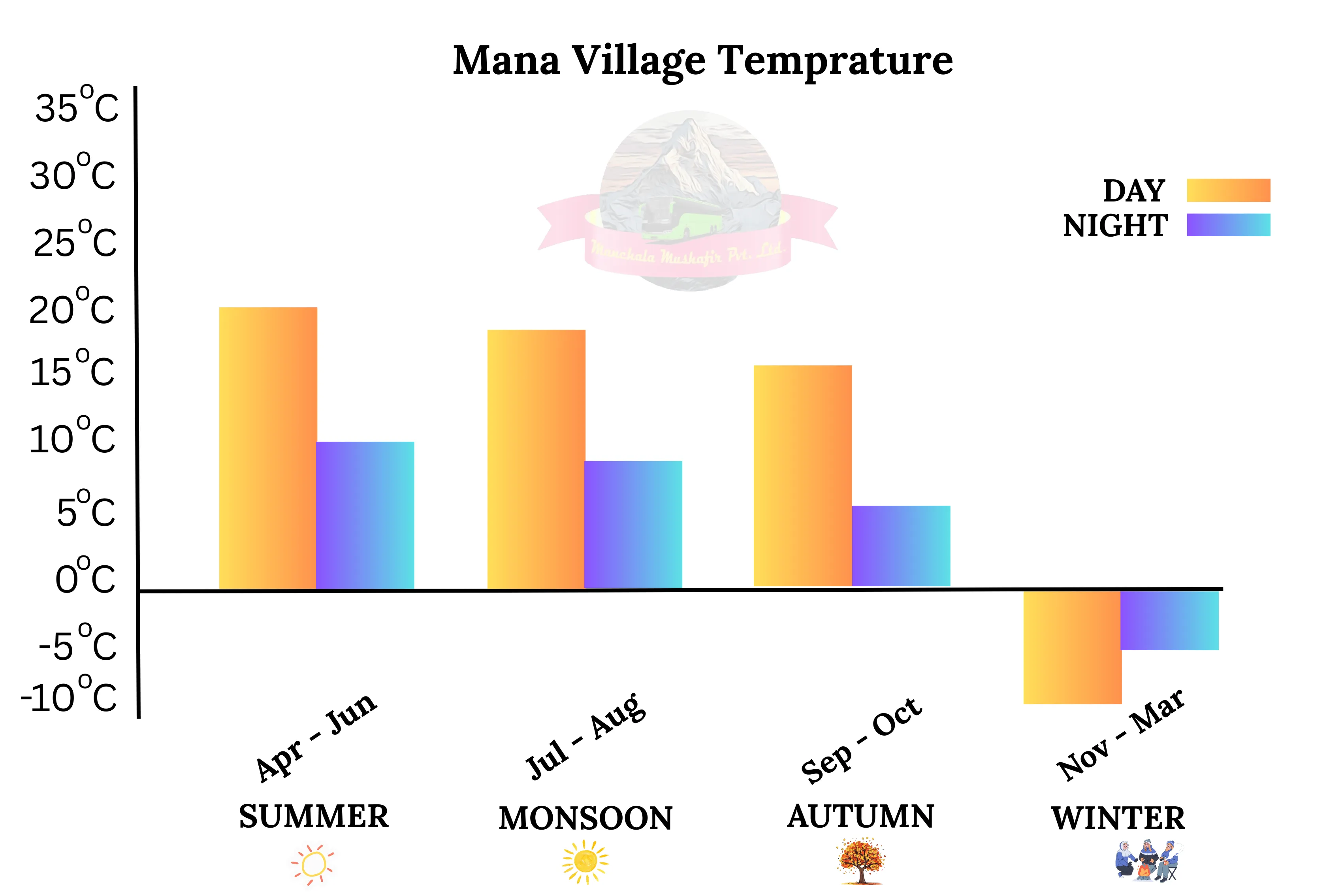
Mana Village Temperature by Season (Summer, Monsoon, Winter)
Summer season (April to June)
: During the summer, the weather is pleasant with clear skies and mild temperatures, making it the perfect time to escape from the heat of the plains.
Temperature
: ranges from 10°C to 20°C.
Conditions:
days are warm, but evenings and nights can be chilly. Clear weather and views make it an ideal time for cultural walks and sightseeing.
Monsoon Season (July-August)
: During the monsoon, the village experiences heavy rainfalls that increase the risk of landslides and flash floods.
Temperature:
Temperature ranges from 8°C to 18°C with high humidity.
Conditions:
Travelling might be risky at this time, as the heavy rain makes the trails slippery.
Autumn Season (Sep-Oct):
Post-monsoon is another ideal time to visit Mana village, as the rain starts retreating at this time, the weather becomes pleasant again, and the landscapes become lush.
Temperature
: typically ranges from 5 °C to 15 °C.
Conditions
: The village and trails are accessible at this time. The surrounding lush greenery and clear views are perfect for trekking and photography.
Winter Season (Nov-Mar)
: Winters in Mana are harsh and extreme, with minimal temperature ranges. The village becomes inaccessible due to heavy snowfall.
Temperature
: ranges from -5c to -10 °C.
Conditions
: The whole region is covered with snow. Harsh weather conditions with heavy snowfall make travel to this village difficult or impossible.
Best time to Visit:
The ideal time to visit Mana Village is during the pilgrimage season from May to June and September to October
, as these months offer favourable weather conditions with clear skies and views, and trails are also accessible at this time. Avoid the monsoon and winter months, as the village experiences heavy rainfall, causing a danger of flood, landslide, road blockage and many more.
How to reach Mana Village from Delhi:
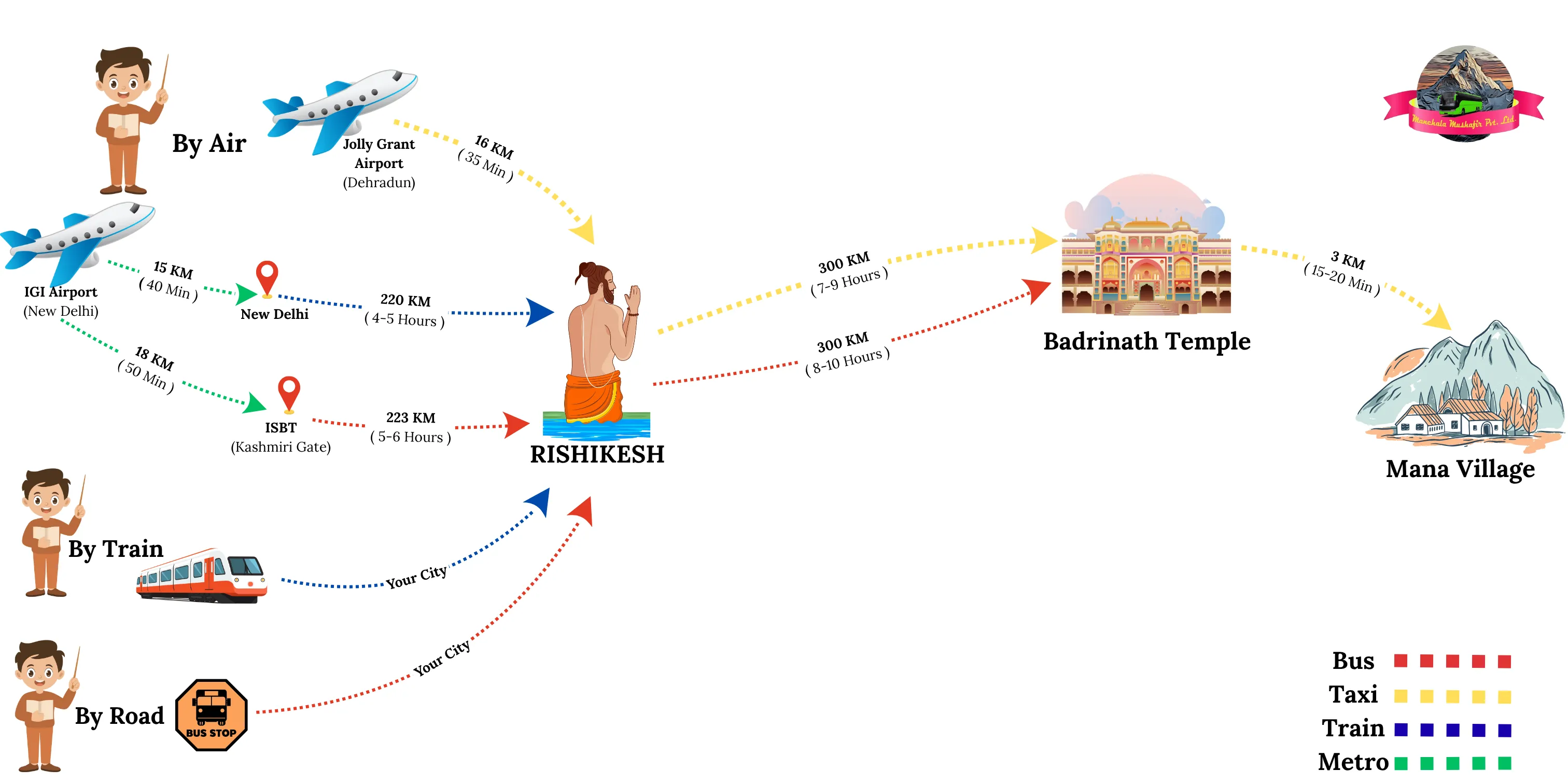
To reach Mana Village from Delhi, firstly, you need to travel to Badrinath (approximately 540 km from Delhi). The journey involves multi-stage travel, including by road, train, or air, and a combination of those. Here is the complete detail on the routes and transport options to reach Mana village from Delhi.
First Stage—Travel from Delhi to Badrinath: Badrinath is accessible by road, train, or air.
By Air and road (most economical)
Fly to Dehradun from Delhi: Take a flight from Delhi’s Indira Gandhi Airport to Dehradun Jolly Grant Airport. The flight takes about an hour to complete.
Dehradun to Badrinath: From the Airport, you can take a private taxi or bus to reach Badrinath, which is approximately 310 km from the airport, and it takes 6-8 hours to cover.
By Train and Road (most convenient and fastest)
Take a train to Haridwar or Rishikesh: As there is no direct train connectivity to Badrinath or Mana, Haridwar and Rishikesh railway stations are the nearest stations to Badrinath. So you can take a train to Rishikesh ( the most common stop) from Delhi.
Continue by road to Badrinath from Haridwar/Rishikesh: From Haridwar or Rishikesh, you will need to hire a private taxi or government bus operated by UTC(Uttarakhand Transport Cooperation) to reach Badrinath.
By Bus (Road Travel)
Bus from Delhi to Haridwar/Rishikesh: Take a bus from Delhi’s ISBT Kashmiri Gate to Haridwar/Rishikesh.
Continue to Badrinath from Haridwar/Rishikesh: from there, take another bus or taxi to reach Badrinath.
Second Stage— Badrinath to Mana Village
As we know, the village is just
3km away from Badrinat
h. The distance can be covered by a short taxi ride or a shuttle walk.
By a short taxi ride: From the Badrinath temple, you can take a shared jeep or taxi to reach Mana village, which takes 15-20 minutes.
By shuttle walk: The distance of 3 km between Badrinath and Mana Village can be covered by a 30-minute shuttle walk.
|
Stage
|
Mode
|
Route
|
Approx.
Distance/Time
|
|
Delhi →
Badrinath
|
By Air
+ Road (Economical)
|
Delhi →
Dehradun (Flight) → Badrinath (Taxi/Bus)
|
Delhi–Dehradun:
1 hr (flight) Dehradun–Badrinath: 310 km, 6–8 hrs
|
|
Delhi →
Badrinath
|
By
Train + Road (Convenient & Fast)
|
Delhi →
Haridwar/Rishikesh (Train) → Badrinath (Taxi/Bus)
|
Delhi–Rishikesh:
5–6 hrs (train) Rishikesh–Badrinath: ~300 km, 8–10 hrs
|
|
Delhi →
Badrinath
|
By Bus
(Road Travel)
|
Delhi →
Haridwar/Rishikesh (Bus) → Badrinath (Bus/Taxi)
|
Delhi–Rishikesh:
6–7 hrs Rishikesh–Badrinath: ~300 km, 8–10 hrs
|
|
Badrinath
→ Mana Village
|
Taxi/Shared
Jeep
|
Badrinath
→ Mana Village
|
3 km,
15–20 min
|
|
Badrinath
→ Mana Village
|
On Foot
(Shuttle Walk)
|
Badrinath
→ Mana Village
|
3 km, 30
min walk
|
Accommodation & Food Options at Mana Village
Accommodation at Mana Village: There are various accommodation options in Mana Village, including Homestays, Guesthouses, and lodges. The best accommodation options are available in the nearby town of Badrinath, so it is recommended that you book your stay in Badrinath.
Some convenient hotels in Mana Village are Badrin Resort Mana, Buddy Hikers Stay Badrinath, and GMVN guesthouses. You can find and book these through the various travel websites, such as Goibibo and TripAdvisor.
Food option: You can find a variety of small local eateries and restaurants in Mana village, which serve north indian and local cuisine. Options for light snacks are also available, catering to visitors who are exploring this village.
Top Packages
Kedarnath Yatra
⏳ 4 Days / 3 Nights
₹9,500
View Tour
|
Do Dham Yatra Package
⏳ 5 Days 4 Nights
₹14,500
View Tour
|
Char Dham Yatra
⏳ 9 Days / 8 Nights
₹24,500
View Tour
|
Places to Visit In Mana Village
✓ Vyas Cave and Ganesh Cave: Vyas Cave and Ganesh Cave lie in Mana village and are famous for their simplicity and calmness, along with their ancient beliefs and mythology. Both of these caves are famous and must-visit in Mana village, and the story that makes this place known for its ancient history
✓ Bheem Pul and Saraswati river: The enchanting views around the Bheem Pul are a lovely attraction of Mana village that makes it prominent among the visitors, and the scenic views with the ancient tales are like the cherry on the cake here.
✓The tale about the Bheem Pul: The final flourish of the Bheem Pul is the Saraswati River. Flaunting itself, the Saraswati River beautifully flows below the Bheem Pul, attracting the attention of the visitors and making sounds with its speedy flow. That is why it is also known as a fast-flowing river.
Nearby Places to Visit around Mana Village
1. Vasundhara falls
Vasundhara Falls is located near Mana village in Uttarakhand near Badrinath temple, and the walking distance to Vasundhara Falls is about 6 km from Bheem Pul in Mana. The water falls from an altitude of 400 ft. and seems pure white, like milk. This route may be easy for experienced climbers, but not at all easy for beginners, as the slopes are very steep, the simplicity of this place is fatal and not at all easy to describe. So, if you want to go on another mesmerising trip, Vasundhara Falls, with its 6 km-long trail, is the best choice. The Mighty Himalayan mountains surrounding Vasundhara Falls make the view scenic and invite several tourists throughout the year. The perfect scenery and the water in the form of crystal-clear pearls will make you love it. So let's take in the stunning views of Swaragohini along the 3-hour route.
2. Tapt kund
Tapt Kund
is a hot spring near the Badrinath temple where pilgrims take a dip. The spring is prominent among devotees because it is naturally hot; even at the lowest temperature, the water here remains hot throughout the year.
It is believed that once a person takes a Dip in it, that individual is free from all skin diseases for life. And this fact makes it a must-visit around Mana village. Tapt Kund is dedicated to Lord Agni and is at a distance of 5.2 km, which can be travelled in 16 minutes, near Mana.
3. Pandukeshwar
Another beautiful city near Mana village is
Pandukeshwar
, which also serves as the winter seat of lord Badri and is home to Yogdhyan Badri, one among the sapt badri temples and is located at a distance of 26 kms from Mana village and 17 kms from Joshimath.
4. Mata Murti Temple
Mata Murti Temple is one of the most popular tourist attractions in Badrinath and attracts tourists every year. The temple is dedicated to the goddess Mata Murti, another form of goddess Lakshmi known for wealth and prosperity. According to the local legends, the beliefs about the history of this place say that at this place, Mata Murti requested Lord Vishnu and asked him to give birth to her son, and afterwards, Lord Vishnu was born in the form of Nar Narayan and completed her wish. The temple is considered one of the holiest pilgrimage sites in Hinduism. It is located on the banks of the Alaknanda River, at a distance of 6.1 km from Mana village, and can be reached by a 25-minute ride.
Travel Tips for Mana Village
Mana village is located at a very high altitude with the potential for altitude sickness, so prepare for it.
Acclimatisation:
Badrinath allows for acclimatisation, so spend time here before heading to Mana village.
Packing Essentials:
Pack warm clothes, bring cash, required permits, health and safety items, and other essential items, such as a Power bank, a Flashlight, and sturdy trekking boots.
Road conditions and weather conditions:
Weather in the high region is changeable with the possibility of sudden rain, so be prepared for it, and road conditions are also affected by the weather, so check the accessibility of the roads.
Stay connected & stay Hydrated:
Inform your family or friends about your trip, stay connected with them, and stay hydrated to reduce the risk of altitude sickness.
Respect local customs
and follow the local guidelines of the village.
Book your accommodation in advance
.
FAQ'S
What is Mana Village famous for?
Mana village is famous for many things. First of all, it is mostly famous as the First Village of India or the Last Village of India from the Tibetan side. In addition to this, Village Uttarakhand is also famous for its high-quality woollen clothes and handicrafts. In farming, it is famous for growing top-quality potatoes and Kidney beans.
How far is Mana village in Uttarakhand from the China border?
Mana Village is located just 24 km away from the China border. And it is the first village of India from the China border. So it is most famous as the first village of India.
Is Mana really the last village of India?
No, Mana is not considered the last village of India, while formally, the Mana Village is known as the “Last inhabited Village of India,” now it is promoted as the “First village of India,” situated on the border of India-Tibet (China). The Chief Minister of Uttarakhand declared that the village should now be known as the “First Indian Village.”
What is the altitude of Mana Village?
The village is situated on the banks of the Saraswati River at an altitude of 10,561 feet (3,219 meters) above sea level, and it is surrounded by snow-capped Himalayan peaks.
Can you visit Mana in Winter?
No, generally the village becomes inaccessible, as during the winters the village experiences extremely harsh weather conditions with the possibility of snow. Snowfall is making this region inaccessible. Both Badrinath and the village closed at this time. The best time to visit Mana is from May to October, as the roads are open and the weather is pleasant at this time.
What is the distance from Badrinath to Mana Village?
The distance from Badrinath to Mana Village is just 4 km. It can be covered by a short drive by taxi, which takes 15 minutes, or on foot. Many travellers opt to walk from Badrinath to Mana, as it is considered easy and offers scenic views of the surrounding Himalayan peaks.
Conclusion
Mana, recognised as the “First Indian Village,” is located in the Chamoli district of Uttarakhand at an altitude of 10,561 feet. The village is renowned for its stunning natural beauty and diverse culture, and it also holds great mythological significance.
According to the Mythology, the Mahabharata was composed by sage Ved Vyasa with the help of lord Ganesh at this sacred spot. The Village features many spiritual and scenic sites, such as Vyas Gufa, Ganesh Gufa, Vasudhara falls, and Bhima Pul, which provide an opportunity for Trekking, Photography, and the cultural walk.
The village is surrounded by the lovely Himalayan landscape and peaks, which offer breathtaking views. If you plan to visit Mana village, there are some things to consider, including checking the best time to visit, weather conditions, acclimatising properly in Badirnath, staying connected, respectful behaviours, and planning your trip time-wise if you want to cover all the main sites near the village. These are the things to consider before visiting Mana village that ensure a safe, smooth, and memorable journey.
You may like
Badrinath VIP
Darshan
Pandukeshwar: The
Spiritual Gateway to Badrinath
Tapt Kund: The Healing Hot
Spring Near Badrinath Temple
Vasudhara Falls:
Witness the Mysterious Waterfalls Near Mana Village
Joshimath: The Gateway to
Badrinath and Auli
Top
7 Places to visit around Kedarnath and Badrinath Temple
Panch Badri Temples
Top Packages On This Route
Kedarnath Yatra
Kedarnath Packages From Bangalore
Kedarnath Trip From Pune
Do Dham Yatra Package
Char Dham Yatra from Haridwar
Char Dham Yatra Packages from Ahmedabad
Char Dham Yatra Packages from Hyderabad
Char Dham Yatra Packages from Bangalore
Char Dham Yatra Packages from Pune
Uttarakhand Top Blog
Winter Char Dham of Uttarakhand
Top 7 Temples of Uttarakhand
Top 7 Trekking Destinations of Uttarakhand
Explore the Beauty of Gopeshwar, Uttarakhand
Most Popular Temples in Uttarakhand
Top 10 Weekend Treks in Uttarakhand
Panch Prayag in Uttarakhand
Top 12 Places to visit during Char Dham Yatra | Uttarakhand
Gaurikund Uttarakhand
Bhairav Nath Temple, Uttarakhand
Chopt, a Uttarakhan: Unveiling The Serene Paradise of The Himalayas
Best Solo Treks in Uttarakhand
Uttarakhand Hill Stations: Explore The Majestic Beauty
Top 12 Tourist Destinations in Uttarakhand
Lohajung Village, Uttarakhand: Gateway to Himalayan Treks
Is 5000 Enough For Kedarnath? Budget Guide 2026
Places To Visit In Gangotri
Lakhamandal Temple, Uttarakhand: An Ancient Shiva Temple
Vyas Gufa And Ganesh Gufa In Mana Near Badrinath
Karnaprayag Uttarakhand
Rudraprayag Sangam - Uttarakhand
Vishnuprayag: The Sacred Sangam of Alaknanda and Dhauliganga
Adi Badri Temple, Uttarakhand
Nandaprayag
Vridh Badri Temple, Uttarakhand – Legends, How to Reach & Best Time
Best Hotels In Rishikesh, Uttarakhand 2026 Guide
Hotels In Haridwar: Best Places To Stay In Haridwar 2026
Charan Paduka, Badrinath—Sacred Footprints of Lord Vishnu
Bheem Pul Story and Significance
Badrinath Temple 2026
Top 10 Best Places To Visit Near Badrinath Temple
Top Places to Visit in and Around Triyuginarayan Temple 2026
Do Dham Yatra by Helicopter
Best Travel Agency In Haridwar
9 Best trekking destinations of India
Winter seats of Panch Kedar Temples
Sapta Badri Temples
Top 7 Places to visit around Kedarnath and Badrinath Temple
Panch Badri Temples
Haridwar, Uttarakhand: A Place of Spiritual Healing
Auli – The Winter Wonderland
Agastya Muni: A Sacred Place of Peace and Devotion
Pandukeshwar: Gateway to Badrinath
Hemkund Sahib -The Highest Gurudwara In The World
Tapt Kund: The Healing Hot Spring Near Badrinath Temple
Vishwanath Temple Uttarkashi
Why You Should Visit Surya Kund Yamunotri Natural Hot Spring
Joshimath: The Gateway to Badrinath and Auli
Barkot Uttarkashi: Best Places to Visit & Things to Do
Gartang Gali: The Wooden Bridge Trek Route
Vasudhara Falls: Witness the Mysterious Waterfall
Harsil Valley: The Hidden Gem of the Himalayas
Kartik Swami Temple
Most Famous Temples in Uttarakhand
Chopta Trek: A Himalayan Adventure Awaits
Panch Prayag Uttarakhand
Gangotri Temple: The Abode of Maa Ganga
Yamunotri Temple
Chorabari lake – The Pristine lake near Kedarnath Temple
Kalimath Temple Rudraprayag Uttarakhand Guide 2026
Rudranath Temple – Toughest among the Panch Kedar
Mana Village: The First Village of India
All About Dhari Devi Temple
Triyuginarayan Temple: A Sacred Place
Unveiling The Hidden Wonders Of Makkumath
All about Ukhimath and Places to visit around- Travel Guide
.webp)