Introduction
Char Dham Yatra is a sacred Hindu pilgrimage, which involves visiting four revered temples, including Yamunotri, Gangotri, Kedarnath and Badrinath , nestled in the Garhwal region of Uttarakhand at very high altitudes. It symbolises a spiritual journey and is believed to cleanse sins and lead to salvation for pilgrims. Each shrine is dedicated to a different deity and is associated with great mythology, attracting many pilgrims.
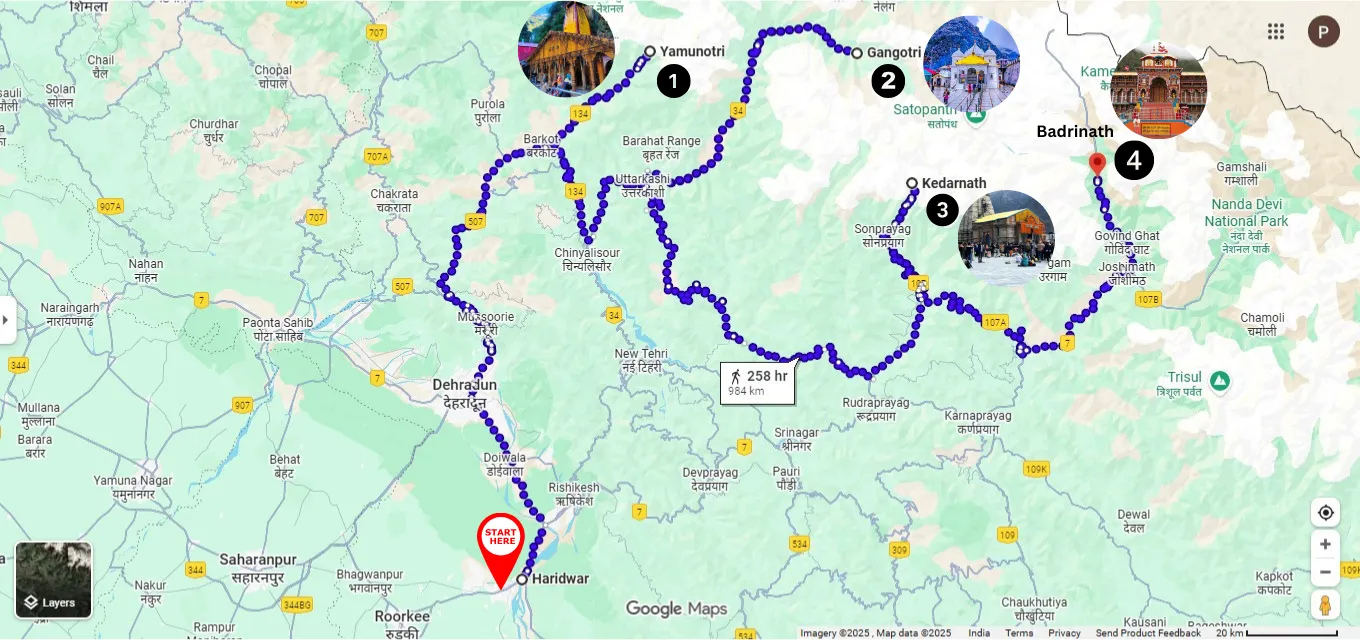
The Yatra takes place in the summer months from April to October, and it pauses in winter due to heavy snow. It follows a traditional clockwise route, starting from the Yamunotri temple , proceeding to Gangotri and Kedarnath, and ending at Gangotri.
The Sacred Char Dham Yatra holds great significance; it lies in cleansing the sins and achieving spiritual liberation, and promising spiritual fulfilment. Every year, thousands of devotees seek the divine blessing of deities for their inner peace and growth.
Each temple of Char has a great history, deeply associated with Saint Adi Shankaracharya, who played a great role in reestablishing these sites. While Kedarnath and Badrinath are rooted in ancient texts such as the Mahabharata and the Skanda Purana.
If you are spiritual seekers and pilgrims for Char Dham, Do Dham and Kedarnath yatra , this blog is for you, covering the spiritual, cultural and historical significance of Char Dham Yatra.
Spiritual Significance Of Char Dham Yatra
Char Dham Yatra holds a great spiritual significance in Hindu culture. Four temples are included in this holy pilgrimage are Yamunotri, Gangotri, Kedarnath and Badrinath. Most of the time it is also referred to as Chota Char Dham Yatra or Char Dham Yatra of Uttarakhand. It is strongly believed that, by this holy pilgrimage, we can clean our sins, achieve spiritual purification and attain salvation.
The yatra is a perfect blend of spiritual and natural beauty, perfect for spiritual enthusiasts and nature lovers, making it a once-in-a-lifetime journey. The journey involves a strenuous trek in Yamunotri and Kedarmath, testing the faith and endurance and teaching lessons of life struggles, perseverance and self-growth.
Path To Salvation (Moksha) : According to Hindu beliefs, pilgrims who undertake this yatra will purify their souls, wash away sins, and be led to spiritual awakening and also towards achieving Moksha (freedom from the cycle of birth and death).
Here is a breakdown of the significance of each dham.
Significance OF Each Dham
Yamunotri: Symbol of Purification
Yamunotri is the first crucial stop of the Char Dham Yatra; it’s a divine source of the Yamuna river and is dedicated to Goddess Yamuna, the twin sister of God Yama and the Daughter of Surya.
The temple sits at an elevation of 3,293 meters (10,804 feet) above sea level and is renowned for its thermal springs, like Surya Kund and stunning natural beauty.
The significance of the shrine is linked with the sage Asit Muni Devotion, who meditated and practised daily bathing rituals in the sacred Yamuna River, making it a symbol of purity and divine grace.
Pilgrims believed that taking a bath in the Yamuna river cleanses their sins, purifies their soul and protects them from untimely death.
Architecture Note: Built by Sudarshan Shah, the king of the Tehri Garhwal region, in the 18th century. built in Garhwali architecture.
Gangotri: Symbol of Spiritual Enlightenment
Gangotri, the divine source of the Ganga River, is the second stop of the yatra. The temple is dedicated to Goddess Ganga and is situated at an altitude of 3,100 meters (10,200 feet) above sea level, surrounded by snow-capped peaks. It is associated with the legend of King Bhagirath, who performed deep penance at this sacred spot, near Bhagirathi shilla, for the descent of the revered Ganga (known as Bhagirathi) on earth from heaven and to purify his ancestors. After being affected by his devotion, lord shiva released Ganga from his Jata (matted hair).
It is believed that taking a bath in the Bhagirathi River abolishes sins and grants salvation for visitors; it symbolises spiritual enlightenment and knowledge.
Kedarnath: Symbol of Divine Consciousness
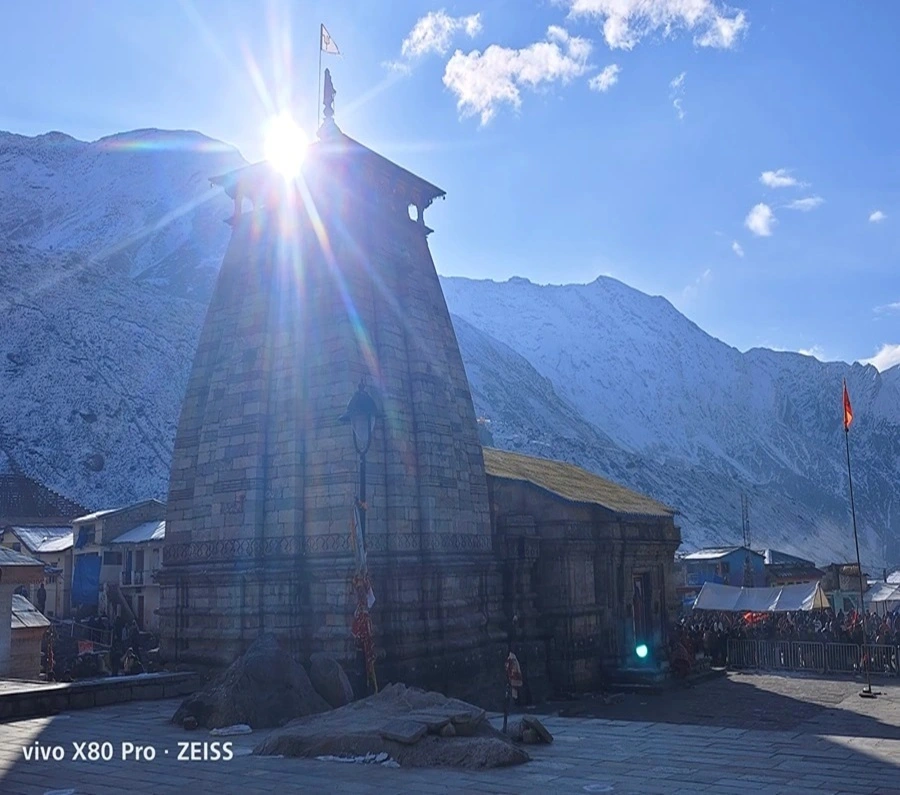
Kedarnath, the abode of lord shiva, part of the Panch Kedar and 12 Jyotirlinga (sacred temples of lord shiva), is a key part of the Yatra. The temple sits at an altitude of 3,583 meters (11,755 feet) above sea level on the banks of the Mandakini River.
It holds great mythological significance and is associated with the epic Mahabharata. According to Hindu mythology, the temple was built by the Pandavas, who were seeking forgiveness to atone for the sins of killing their kinsman in the Mahabharata War. Lord Shiva appeared in the form of a Bull, representing the hump of a bull, which is worshipped as the idol of a canonical rock formation (Shiva Linga).
Kedarnath trek starts from Gaurikund , passes through the Himalayas, and involves walking on uneven terrain, symbolising a journey of self-growth and self-realisation. The total trekking distance of Kedarnath temple from Gaurikund is 16 kms from Gaurikund. Every year, thousands of devotees visit Kedarnath to seek the divine blessings of lord shiva and to enrich their spiritual experience.
It is believed that, by visiting to Kedarnath temple, one gets rid of sins and helps them to achieve salvation.
Badrinath: Symbol of Knowledge & Protection
Badrinath, the abode of lord vishnu, is part of the sacred Panch Badri, Sapt Badri, and 108 Divya Desam. Located in the Chamoli district of Uttarakhand at an altitude of 3,133 meters (10,279 feet) above sea level. Lord Vishnu is in a meditative position in this temple.
It holds immense spiritual significance in Hinduism. It is believed that lord vishnu meditated at this sacred spot to save the world from destruction, and Goddess Laxmi took the form of a Badri tree to protect lord Vishnu from the harsh climate, which gave the place its name. This is the final destination of the pilgrimage journey, marked as the completion of the sacred Char Dham Yatra.
Connection Of Each Char Dham With Adi Shankaracharya
Adi Shankaracharya was a great philosopher of the 8th-century Ancient India, who played a great role in revitalising Hinduism. He travelled in Uttarakhand to reestablish the four Himalayan shrines called Chota Char Dham (Yamunotri, Gangotri, Kedarnath and Badrinath) to unify divine Hindu traditions. He is the person who preached the significance of the Char Dham yatra to the locals.
Role in Reviving Char Dham : He revived the Kedarnath and Badrinath shrines; he found the idol of Lord Badrinarayan in Narad Kund and reinstalled it in the temple. He also established Jyotirmath (now known as Joshimath ) as the major centre for the study of Advaita Vedanta.
He provides pilgrimage routes that encompass all these four major shrines, as Shakti at Yamunotri and Gangotri, Shiva at Kedarnath and Vishnu at Badrinath.
It is believed that Adi Shankaracharya was an avatar of Lord Shiva, dedicated to restoring Hindu Dharma. He attained Moksha at Kedarnath; his samadhi, located behind the temple, is marked as a significant spiritual site.
Thus, his efforts transformed these Himalayan shrines into a major pilgrimage circuit, which also helps in promoting unity among Hindus.
Geographical And Natural Significance Of Char Dham
Geographical Location: All the Char Dham temples are situated in the upper Himalayan region of Uttarakhand, called the devbhoomi (land of gods) and one of the most diverse regions of India. The shrines lie in the high Himalayan ranges at very high altitudes.
Rivers originate and flow from the sacred dham
-
Yamunotri
(
Origin of the Yamuna River)
: The Yamuna River, the second most sacred river in Hinduism, originates from the Yamunotri (Chamabasar Glacier), near the Yamunotri temple. The region is surrounded by peaks, thermal hot springs and alpine meadows, making it a perfect Himalayan wonder.
-
Gangotri (Origin of Ganga River) : Gangotri is the source of Ganga, originating from Gangotri Glacier as Bhagirathi and later becoming Ganga after meeting the Alaknanda River at Devprayag .
-
Kedarnath : Kedarnath is situated along the significant riverbank called Mandakini, which flows beside the Kedarnath temple.
-
Badrinath : Badrinath temple sits on the banks of the Alaknanda River, which flows alongside the temple.
Since the entire route of Char Dham is dotted with Panch Prayag (Five sacred confluences of holy rivers).
Cultural And Traditional Significance Of Char Dham
Beyond the spiritual and religious significance, the Char Dham temples are symbols of India’s living culture and ancient traditions. For many years, these temples have shaped customs, rituals, languages and spiritual lifestyles, which are practised by devotees and villagers.
-
Rituals and Traditions : This pilgrimage journey involves specific rituals at each shrine, such as holy bathing in the Yamuna and Ganga rivers and collective aarti ceremonies, which provide a profound spiritual experience.
-
Festival Celebration : Char Dham temples are the focal points for cultural festivals. Most famous festivals celebrated in Char Dham temples are: Kapat opening and closing ceremony, called Utsav Murti Mela, Mahashivratri at Kedarnath, Ganga Dussera at Gangotri and Badri-Kedar Utsav at Badrinath and Kedarnath. These are annual festivals of Char Dham.
Socio-Economic Significance Of Char Dham Yatra
Char Dham holds deep social and economic significance, as these shrines are major spiritual hubs of Uttarakhand. Every year, thousands of pilgrims visit these sacred shrines, which helps generate livelihood, strengthening not only local economies but also helping in state economic growth.
Economic Importance:
-
Sources of livelihood of local villagers : The Char Dham Yatra is a major revenue generator for thousands of families, including priests, porters, drivers, guides, travel agents and local shopkeepers.
-
Boost Tourism Economy : The craze for these journeys increased day by day, which played a great role in religious tourism revenue and state income. It also boosts small businesses like Homestays and eateries.
Social Importance:
-
Community Development: The yatra strengthens social bonds through encouraging seva and brings people together of different castes, communities and languages, which helps to achieve spiritual goals and connect with deities.
-
Women Empowerment: Due to the increasing significance of the yatra, women play an important role in many areas, such as homestay management, local food preparation and handmade craft production and sale.
Popular Packages
|

|

|
FAQs
-
What is the spiritual importance of Char Dham in Uttarakhand?
The spiritual importance of Char Dham in Uttarakhand lies in its promise of Moksha (salvation). This sacred pilgrimage is believed to wash away sins and facilitate spiritual awakening through the blessings of four primary deities: Goddess Yamuna (Yamunotri), Goddess Ganga (Gangotri), Lord Shiva (Kedarnath), and Lord Vishnu (Badrinath).
-
What happens if we do complete the Char Dham Yatra?
Char Dham Yatra is not just a travel or a mode to get rid of Sin or achieve salvation. In addition to this, it is a bridge to find your inner self and connect to the divine power. It also helps us to experience the divine beauty of nature.
-
Who started the Char Dham Yatra?
As per the holy scriptures, it is believed that this yatra was first done by the Pandavas after the war of Kurukshetra. But after multiple invasions and natural disasters, this yatra lost its popularity.
Later on, it was re-established by the 8th-century Indian philosopher Adi Shankaracharya. He set up all four shrines as a spiritual circuit to consolidate Hindu beliefs and to unify the pilgrimage circuit across India, and taught everyone about the significance of Char Dham Yatra.
-
What is the significance of the Yamunotri temple?
Yamunotri temple is a significant pilgrimage site, first among the Char Dham yatra, dedicated to the Goddess Yamuna. The site is renowned as the origin of Yamuna River, believed to be taking a bath in this river, grant salvation from untimely death, and it also releases from the fear of Yama (god of death and twin brother of the Goddess Yamuna).
Beyond its spiritual significance, the site is also known for stunning Himalayan beauty surrounded by snow-clad Himalayan peaks and popular for natural Hot springs, like Surya Kund.
-
What is the significance of Kedarnath Dham?
The significance of the Kedarnath temple lies in the Mahabharata legend. Believed that the temple was built by the Pandavas, who sought Shiva’s absolution after killing their kinsmen in the Kurukshetra war. It is one of the 12 Jyotirlinga, Panch Kedar and a key Char Dham site, surrounded by snow-clad peaks and river valleys.
-
What is the purpose of Char Dham Yatra?
The key purpose of Char Dham Yatra is to cleanse the sins, purify the soul and attain salvation for the visitors. Pilgrims who undertake the journey, which follows a traditional clockwise route, starting from Yamunotri and ending at Badrinath, can bring profound blessings and longevity.
Uttarakhand Top Blog
Winter Char Dhams of Uttarakhand
Top 7 Trekking Destinations of Uttarakhand
Explore the Beauty of Gopeshwar Uttarakhand
Most Popular Temples in Uttarakhand
Top 10 Weekend Treks in Uttarakhand
Top 12 Places to visit during Char Dham Yatra | Uttarakhand
Top Nine Places to Visit in Uttarakhand
Kalimath- A Holy Shaktipeeth Uttarakhand
Madhyamaheshwar Temple Uttarakhand
Bhairav Nath Temple Uttarakhand
Chopta Uttarakhand Unveiling The Serene Paradise of The Himalayas
Best Solo Treks in Uttarakhand
Uttarakhand Hill Stations: Explore The Majestic Beauty
Top 12 Tourist Destinations in Uttarakhand
Lohajung Village Uttarakhand Gateway to Himalayan Treks
Is 5000 Enough For Kedarnath? Budget Guide 2026
Lakhamandal Temple Uttarakhand: An Ancient Shiva Temple
Vyas Gufa And Ganesh Gufa In Mana Near Badrinath
Rudraprayag Sangam - Uttarakhand
Vishnuprayag: The Sacred Sangam of Alaknanda and Dhauliganga
Vridh Badri Temple, Uttarakhand – Legends, How to Reach & Best Time
Best Hotels In Rishikesh Uttarakhand 2026 Guide
Hotels In Haridwar: Best Places To Stay In Haridwar 2026
Charan Paduka, Badrinath—Sacred Footprints of Lord Vishnu
Bheem Pul Story and Significance
Top 10 Best Places To Visit Near Badrinath Temple
Top Places to Visit in and Around Triyuginarayan Temple 2026
Best Travel Agency In Haridwar
9 Best trekking destinations of India
Winter seats of Panch Kedar Temples
Top 7 Places to visit around Kedarnath and Badrinath Temple
Haridwar Uttarakhand: A Place of Spiritual Healing
Agastya Muni: A Sacred Place of Peace and Devotion
Pandukeshwar: Gateway to Badrinath
Hemkund Sahib -The Highest Gurudwara In The World
Tapt Kund: The Healing Hot Spring Near Badrinath Temple
Why You Should Visit Surya Kund Yamunotri Natural Hot Spring
Joshimath: The Gateway to Badrinath and Auli
Barkot Uttarkashi: Best Places to Visit & Things to Do
Gartang Gali: The Wooden Bridge Trek Route
Vasudhara Falls: Witness the Mysterious Waterfall
Harsil Valley: The Hidden Gem of the Himalayas
Most Famous Temples in Uttarakhand
Chopta Trek: A Himalayan Adventure Awaits
Gangotri Temple: The Adobe of Maa Ganga
Chorabari lake – The Pristine lake near Kedarnath Temple
Kalimath Temple Rudraprayag Uttarakhand Guide 2026
Rudranath Temple – Toughest among Panch Kedar
Mana Village : The First Village of India
Triyuginarayan Temple: A Sacred Place
Unveiling The Hidden Wonders Of Makkumath
All about Ukhimath and Places to visit around- Travel Guide
All about Panch Kedar- Legend and Mythology
Tungnath Temple Twelve Fascinating Facts