
Madhyamaheshwar (Madmaheshwar) Temple, Uttarakhand
Category: Travel | Updated On: October 23, 2026 | Published: November 8, 2023
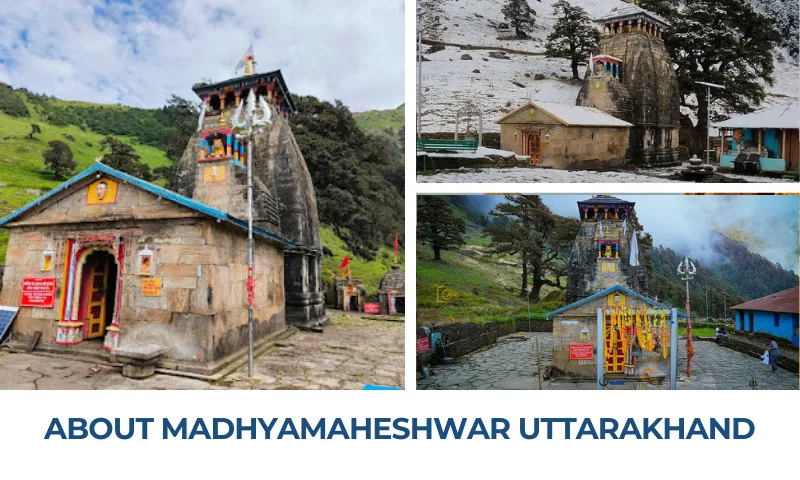
| Quick Facts | Details |
|---|---|
| Location | Gaundar, Rudraprayag district, Uttarakhand |
| Altitude | 3,497 m (11,473 ft) |
| Trek Distance | 16–18 km from Ransi village (base camp), 2–3 days |
| Nearest Road Head | Ransi village (~20 km from Ukhimath) |
| Opening Date 2026 | 21 May 2026 (confirmed) |
| Closing Date 2026 | 16 November 2026 (announced on Vijayadashami, 20 October 2026) |
| Opening Date 2027 | Announced on Baisakhi (around 14 April 2027); usually late May |
| Winter Darshan | Omkareshwar Temple, Ukhimath (mid-November to May) |
| Best Time to Visit | Late May–June and mid-September to mid-November |
Hello, I’m Partiksha , a die-hard devotee of Lord Shiva, and I love to explore the history and ancient temples of Lord Shiva, so I have visited the Kedarnath Dham multiple times, but I have never heard about the Panch Kedar Temple .
Once, when I was traveling with a group through a Kedarnath tour package from Haridwar, they told me about the sacred journey to the Panch Kedar Temples , and I visited them to explore the details of that journey. Madhyamaheshwar is one of the Panch Kedar, so today I am going to share my experience as a pilgrim.
- About Madhyamaheshwar Uttarakhand
- Madhyamaheshwar Shivling
- Madhyamaheshwar History
- Is Madhyamaheshwar a Jyotirlinga?
- How To Reach Madhyamaheshwar Temple
- Step 1: How To Reach Ukhimath
- Step 2: Ukhimath To Madhyamaheshwar Trek
- Madhyamaheshwar Trekking Essentials
- How To Reach Madhyamaheshwar From Haridwar
- How To Reach Madhyamaheshwar From Delhi
- Madhyamaheshwar Distance Chart
- Madhyamaheshwar Weather And Temperature
- Best Time To Visit Madhyamaheshwar Temple
- Madhyamaheshwar Opening And Closing Date 2026
- Places To Visit Around Madhyamaheshwar Temple Trek
- Other Prominent Panch Kedar Temples
- Watch: Madhyamaheshwar Trek
- Plan Your Trip
- Frequently Asked Questions
About Madhyamaheshwar Uttarakhand
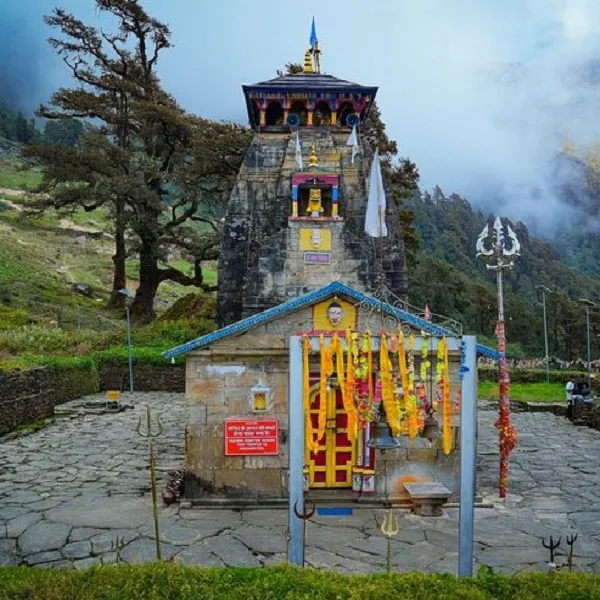
Madhyamaheshwar is a Hindu temple, dedicated to Lord Shiva in Gaundar, a village in Uttarakhand's Garhwal Himalayas. Madhyamaheshwar height is 3,497 m (11,473 ft) above sea level.
It is also an integral part of the Panch Kedar Pilgrimage circuit, which includes the five famous Shiva temple in Uttarakhand Garhwal.
It is believed that the navel (nabhi) or middle (madhya) of Lord Shiva is being worshiped at this sacred temple.
The shivling enshrined inside the temple represents this navel (madhya) form of Lord Shiva — the origin of the temple's name, Madhyamaheshwar.
The circuit includes Kedarnath , Tungnath , Rudranath , and Kalpeshwar Temple , all part of the same Panch Kedar circuit. The traditional visiting order is Kedarnath, then Madhyamaheshwar, then Tungnath, then Rudranath, and finally Kalpeshwar , the fifth and final Kedar.
The Pandavas hold a central position in the Hindu epic Mahabharata, are thought to have built the temple to atone for their sins for killing their kith and kin during the Kurukshetra war.
In this Madhyamaheshwar blog , I am sharing the Madhyamaheshwar Temple height, history, significance, how to reach, best time to visit, and more, along with Madhyamaheshwar Photos to make your sacred journey comfortable and unforgettable, as mine.
Madhyamaheshwar Shivling
The shivling at Madhyamaheshwar represents the navel (madhya) of Lord Shiva — the origin of the temple's name, and one of the five body parts worshipped across the Panch Kedar circuit.
The lingam in the sanctum is a navel-shaped black stone. The temple complex also has smaller shrines, including ones for Goddess Parvati and Ardhanarishvara, and the older Budha (Vriddh) Madhyamaheshwar shrine stands on the meadow about 2 km above the temple. Morning aarti is held around 6:00 AM and evening aarti around 6:00–6:30 PM, though timings can change with the season. Photography is not allowed inside the sanctum; ask the priest before taking photos elsewhere in the complex.
Madhyamaheshwar Temple History
The mythology behind it traces back to the Pandavas, heroes of the Hindu Mahabharata. In the epic Kurukshetra war, the Pandavas defeated and killed their cousins, the Kauravas. They wanted to atone for the sins of fratricide ( gotra hatya ) and Brahmanahatya ( killing of Brahmins — the priest class ) committed during the war.
As a result, they handed over control of their kingdom to their kin and set out in search of Shiva and his blessings. They began their journey in Varanasi (Kashi) , believed to be Shiva's favorite city and home to the Kashi Vishwanath Temple . But Shiva wanted to avoid them because he was so angry about the death and dishonesty at the Kurukshetra war , so he ignored the Pandavas' prayers.
Shiva left Kashi to avoid them. Following him, the Pandavas reached the Garhwal Himalayas and finally came to the village of Kedar.
Where they noticed a large number of animals grazing around. Bhima recognized the deity right away and grabbed the bull by the hump. However, the bull-formed Shiva started disappearing into the ground, then the Pandavas requested him to atone for their sin and worshipped him. Lord Shiva was pleased and appeared in his original form, and the five body parts of a bull appeared at five different places in Uttarakhand.
The hump rising in Kedarnath , the arms appearing in Tungnath , the face appearing in Rudranath , the nabhi (navel) and stomach appearing in Madhyamaheshwar , and the hair appearing in Kalpeshwar all together make it a panch kedar circuit .
The Pandavas, happy with Shiva's reappearance in five different forms, established temples in each of the five locations to honor and worship Shiva. As a result, the Pandavas got rid of their sins.
The shivling worshipped at Madhyamaheshwar today — also referred to locally as Madhyameshwar or Madmaheshwar — is believed to be this same navel form of Lord Shiva that appeared before the Pandavas.
Is Madhyamaheshwar a Jyotirlinga?
No, Madhyamaheshwar is not a Jyotirlinga. It is one of the Panch Kedar temples, where the middle (navel) part of Lord Shiva is worshipped. Of the Panch Kedar temples, only Kedarnath is also one of the 12 Jyotirlingas — so if you've searched "is Madhyamaheshwar Jyotirlinga" or "Madhyamaheshwar is Jyotirlinga," the direct answer is no on both counts. The Panch Kedar and the 12 Jyotirlingas are two separate, overlapping-in-one-place lists of sacred Shiva sites across India; Madhyamaheshwar belongs only to the first.
How To Reach Madhyamaheshwar Temple
Madhyamaheshwar Mandir is a revered pilgrimage site located in the Kedarnath range of the Himalaya in the Rudraprayag district of Uttarakhand. It is one of the quieter Panch Kedar shrines, visited mainly by pilgrims and trekkers in summer and autumn. Here is a short guide on how to reach the Madhyamaheshwar Shivling.
I have divided the Madhyamaheshwar route into two steps–
-
Step 1: Reach Ukhimath from your location
-
Step 2: Madhyamaheshwar Temple Trek from Ukhimath
Step 1: How To Reach Ukhimath
The journey starts by reaching Ukhimath, the gateway town for this trek (see our complete Ukhimath travel guide for routes, fares, and travel times from Delhi, Haridwar, Rishikesh, and Dehradun). From Ukhimath, the Madhyamaheshwar-specific route continues as follows:
Step 2: Ukhimath To Madhyamaheshwar Trek
Once you've reached Ukhimath, the real adventure begins with a Madhyamaheshwar Temple Trek. The Madhyamaheshwar Temple route can be challenging, so it's essential to prepare adequately.
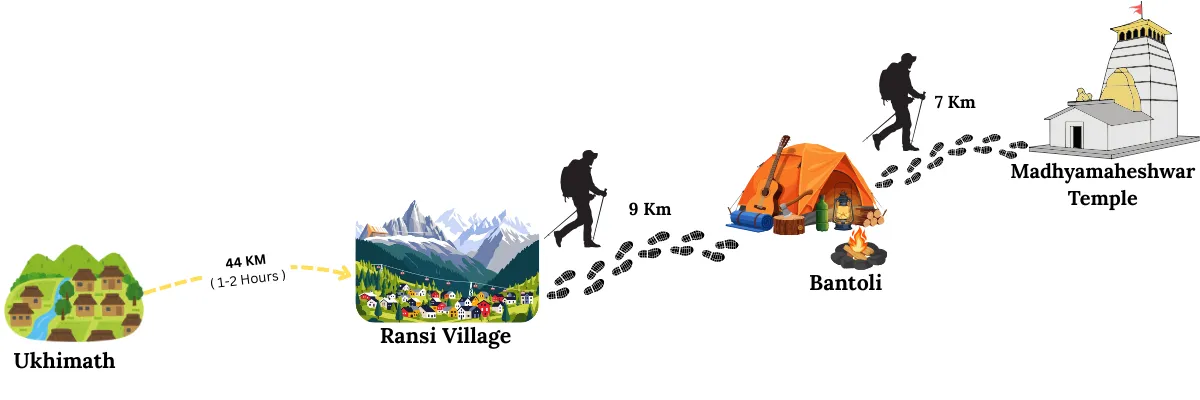
Total Madhyamaheshwar Trek Distance– 16 to 18 km (one way)
Stage 1: Ukhimath to Ransi
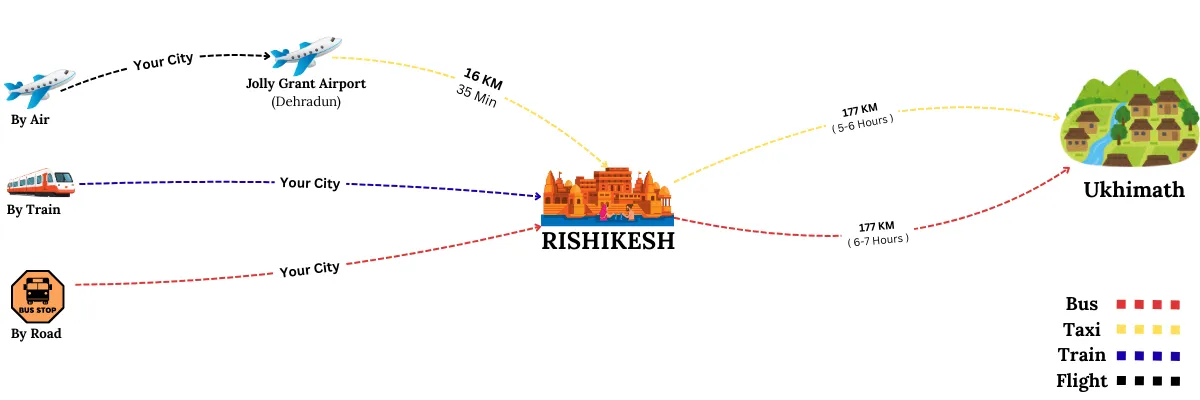
Start from Ukhimath and head to the village of Ransi, which is approximately 20 kilometers away. The road from Ukhimath to Ransi is motorable, and you can either walk or hire a taxi.
Stage 2: Ransi to Bantoli
From Ransi, the trek begins. The trail passes Gaundar village, with short climbs and descents along the valley. After covering about 9 kilometers, you'll reach Bantoli, a beautiful spot to take a break.
Stage 3: Bantoli to Madhyamaheshwar
The final stage of the trek is from Bantoli to Madhyamaheshwar Temple. The trail is relatively high and can be challenging, but the stunning views make it worth the effort. After completing the 7 km trek, you'll reach the temple.
Most trekkers cover this route over two days, with Bantoli serving as the common overnight halt — basic guesthouses and homestays are available there, as well as at Ransi and Gaundar, with simple, freshly cooked, mostly vegetarian meals. The trail is stone-paved for most of its length. The first 9 km to Bantoli are relatively gentle, with short ups and downs, and the last 7 km climb steadily via Khatara, Nanu and Kunchatti to the temple.
The trek is best attempted between late May–June or mid-September to mid-November, while the temple is open. Winter treks are strongly discouraged — heavy snowfall above Bantoli can block the trail entirely, and rescue access becomes difficult.
Madhyamaheshwar Trekking Essentials

Before you begin your journey, make sure to bring the following items given below for a better experience of the trek to the temple:
-
Footwear: Wear high ankle trekking shoes that are durable and comfortable are required.
-
Carry Warm Clothing: Warm clothing is recommended, even in the summer season, as the nights can be cold at high altitudes.
-
Stay Hydrated: Keep a water bottle and ORS to stay hydrated at high altitude, take snacks, including protein bars and dry fruits.
-
Rain Gear: Because the weather is unpredictable, bring a raincoat, jacket, and other gear.
-
Medication: Do not forget to take basic medicines to cure headaches, fever, dizziness, and other health issues.
-
Backpack: A backpack containing necessities such as water, snacks, and a first-aid kit.
How To Reach Madhyamaheshwar From Haridwar
Another famous starting point of the Madhyamaheshwar temple is Haridwar , which is about 204 km from Haridwar to Ukhimath (6-7 hours), plus another 20 km on to Ransi — roughly 224 km and 7-8 hours of driving in total before the trek itself begins. Here you'll get a plethora of options to travel. You can hire a personal cab for yourself, which will stay with you throughout your journey. It will be the costliest among all the options available, but also very safe and recommended for anyone traveling with their family or kids. You can also go for government buses, which ply between these two points at fixed times. This would be economical and best suited for someone planning a backpacking trip.
Rishikesh, the more commonly used gateway for Char Dham and Panch Kedar trips, is closer — about 180 km to Ukhimath (5-6 hours), plus the same 20 km on to Ransi, for roughly 200 km and 6-7 hours of driving before the trek.
How To Reach Madhyamaheshwar From Delhi
If you are not getting a direct commute to Haridwar or Dehradun, you can also reach Delhi. Delhi to Ukhimath is about 420 km (9-10 hours), plus the 20 km on to Ransi — roughly 440 km and 10-11 hours of driving before the trek starts. From Delhi, you can travel in a private vehicle or hire a personal cab to reach Ransi village directly. You can also take a Volvo AC bus from Delhi to reach Haridwar or Rishikesh and then continue your journey by taxi.
If you're travelling via Roorkee — a common stop on the Delhi-Haridwar-Rishikesh route — it's about 52 km on to Rishikesh, then the Rishikesh–Ukhimath–Ransi leg described above (180 km + 20 km). That's roughly 252 km and 7-8 hours of driving from Roorkee before the trek begins.
Delhi to Madhyamaheshwar distance (road + trek) is about 440 km road + 16-18 km trek
Madhyamaheshwar Distance Chart
All road distances below are to Ransi, the last road head; from Ransi, the temple is a 16–18 km trek. Distances are approximate and can change with road diversions.
| From | Road distance to Ransi | Drive time | Route |
|---|---|---|---|
| Delhi | about 440 km | 10–11 hours | Haridwar → Rishikesh → Rudraprayag → Ukhimath |
| Haridwar | about 224 km | 7–8 hours | Rishikesh → Rudraprayag → Ukhimath |
| Rishikesh | about 200 km | 6–7 hours | Devprayag → Rudraprayag → Ukhimath |
| Dehradun | about 245 km | 7–8 hours | via Rishikesh |
| Roorkee | about 252 km | 7–8 hours | via Haridwar and Rishikesh |
| Almora | about 250 km | 8–9 hours | Karnaprayag → Rudraprayag → Ukhimath |
| Ukhimath | about 20 km | 45 minutes–1 hour | Ukhimath → Ransi |
| Kund | about 25 km | about 1 hour | Kund → Ukhimath → Ransi |
| Chopta | about 49 km | 1.5–2 hours | Chopta → Ukhimath → Ransi |
| Kedarnath | 16 km trek + about 70 km road | 1 day | Trek to Gaurikund, drive via Sonprayag, Guptkashi and Ukhimath |
| Rudranath (Sagar road head) | about 95 km road + 20–22 km trek | 2–3 days with the treks | Sagar → Gopeshwar → Chopta → Ukhimath |
Madhyamaheshwar Weather And Temperature
The weather in Madhyamaheshwar offers a wide range of experiences with the change in season and Madhyamaheshwar temperature. Each season serves a unique weather and experience of the Garhwal Region in Uttarakhand.
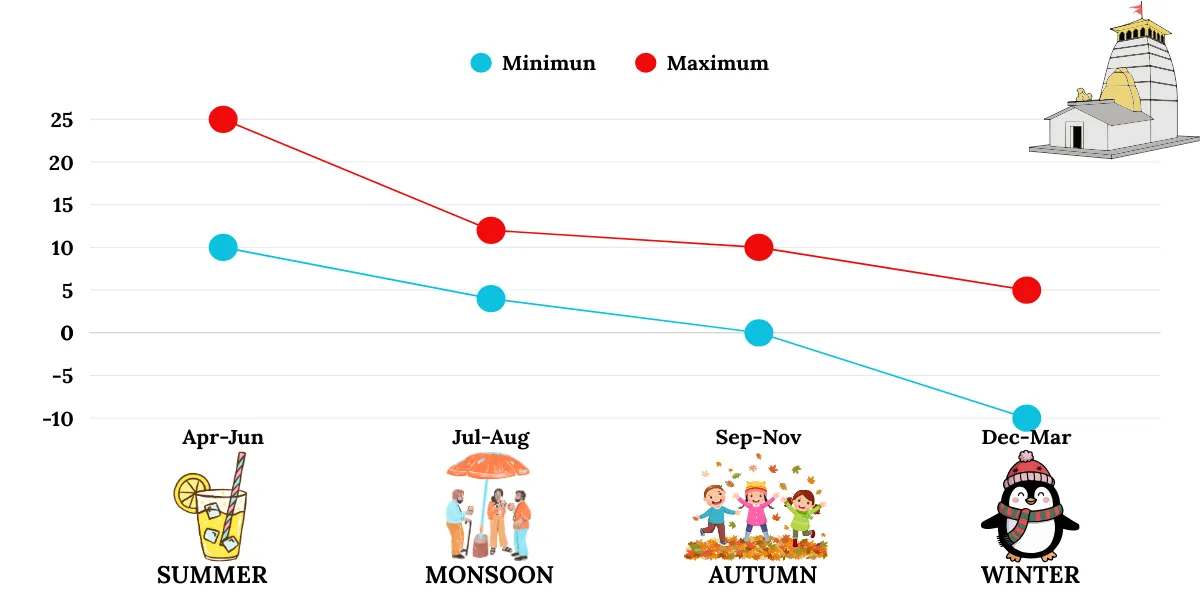
Madhyamaheshwar sees roughly 5°C to 15°C during the peak trekking season (late May–June), dropping much colder — often below freezing — once the monsoon and winter set in. The temple closes for winter specifically because the trail above Bantoli becomes snowbound and impassable, which is why the trek is only recommended from late May to June and from mid-September to the closing date in mid-November.
Madhyamaheshwar Temperature & Weather Chart
Here is the detailed Madhyamaheshwar weather and temperature chart for each season, along with the weather conditions and the offered experience:
Madhyamaheshwar Temperature by Month (Approximate)
| Month | Day | Night | What to expect |
|---|---|---|---|
| May (from the opening, around 21 May) | 10–15°C | 2–5°C | Cool, sunny days; snow patches possible near the temple |
| June | 12–17°C | 5–8°C | Most pleasant month; pre-monsoon showers late in the month |
| July | 12–16°C | 6–9°C | Monsoon rain, slippery trail, landslide risk on roads |
| August | 12–16°C | 6–9°C | Monsoon rain; travel not recommended |
| September | 10–16°C | 3–7°C | Skies clear from mid-September; green meadows |
| October | 6–12°C | −2 to 3°C | Clearest views of Chaukhamba; nights near or below freezing |
| November (until 16 November) | 3–8°C | −5 to 0°C | Very cold; the temple closes on 16 November 2026 |
| Mid-November to mid-May | −5 to 5°C | −15 to −5°C | Snowbound; temple closed, darshan at Ukhimath |
These are approximate temperatures at the temple (3,497 m), compiled from published trek guides; Ransi (about 2,000 m) is usually 6–8°C warmer. In late October, expect roughly 6–10°C during the day and below-freezing nights at the temple, so carry a down jacket and thermals.
Best Time To Visit Madhyamaheshwar Temple
Choosing the suitable month or season to visit the Madhyamaheshwar temple Uttarakhand is a must for a comfortable and safe journey experience. To make your planning easier, we have defined the best time to visit Madhyamaheshwar Temple Uttarakhand.
Summer Season (late May–June): From the opening in late May to June, the summer season offers pleasant sunshine , clear skies , and an ideal trek route with temperatures ranging between 5°C and 15°C . It is considered the peak time for yatra and trekking, so the crowd level is higher at this time.
Autumn Season (September–November): Another good time to visit Madhyamaheshwar Temple is from September to November in the autumn season. The post-monsoon period offers the most stunning views and cool weather , with temperatures ranging from 0°C to 10°C, making it an Ideal time for peace seekers.
Avoid visiting Madhyamaheshwar in Winter and Monsoon: In winter, the temple stays closed due to heavy snowfall and extreme cold weather. The deities shifted to the winter seat of Madhyamaheshwar, Ukhimath. Visiting Madhyamaheshwar in December can be hectic because of road blockage and the closing of the temple. During the monsoon, treks become slippery, and there’s a high risk of landslides due to heavy rainfall.

Madhyamaheshwar Opening And Closing Date 2026

The opening and closing dates of Madhyamaheshwar Temple are decided by the temple committee and priests, aligning with the auspicious dates according to the traditional Hindu calendar.
The Madhyamaheshwar opening date is announced on Baisakhi and usually falls in late May , and the closing date is announced on Vijayadashami and falls after Diwali, in November .
Madhyamaheshwar Temple opening date 2026: The Madhyamaheshwar Temple opened for the 2026 season on 21st May 2026 .
Madhyamaheshwar Temple closing date 2026: The Madhyamaheshwar Kapat closing date 2026 is 16 November 2026 , as officially announced on Vijayadashami (20 October 2026) at the Omkareshwar Temple in Ukhimath. After the doors close, the doli halts at Gaundar on 16 November, Ransi on 17 November and Giriya on 18 November, and reaches the Omkareshwar Temple in Ukhimath on 19 November for winter worship.
Reason: The major reason for the Madhyamaheshwar Temple Trek closing date is that the temple is inaccessible and covered with snow during the winter due to heavy snowfall and extremely low temperatures.
Is Madhyamaheshwar Temple Open in December?
No. The temple is closed from 16 November 2026 until it reopens in late May 2027. From 19 November, the winter worship of Lord Madhyamaheshwar takes place at the Omkareshwar Temple in Ukhimath, which is open all year and can be reached by road. The 2027 opening date will be announced on Baisakhi (around 14 April 2027).
Places To Visit Around Madhyamaheshwar Temple Trek
Some of the most prominent places you can also visit while on the Madhyamaheshwar temple trek are as follows:
Nandikund
The distance between this place and Madhyamaheshwar Uttarakhand, is roughly 10 kilometers, and trekking to Nandi Kund will start from the base village of the Madhyamaheshwar temple trek, i.e., Ransi village. This place is dedicated to Nandi, who is considered to be the avatar and messenger of Lord Shiva. It is located at an altitude of 4,500 meters above sea level in a serene environment surrounded by towering peaks and alpine forest. The beautiful reflection of a snowcapped mountain and lush green forest in the crystal clear water of this lake takes all the show of the Madhyamaheshwar temple trek. Trekking to Nandikund Temple is perfect for anyone looking for an off-beat trek with untouched beauty and a peaceful environment.
Budha Madhyamaheshwar
This place is around 2 km from the main Madhyamaheshwar temple. It's a steep ascent from Madhyamaheshwar temple, but as you ascend, the landscape changes from lush green meadows to rocky terrain. The place gives a panoramic view of Himalayan peaks like Chaukhamba, Kedarnath, and Neelkanth . Located in a peaceful and beautiful location, this place is ideal for meditation and introspection. The place is also best for travelers who are fond of making reels and clicking photos. The place is the best place in nature to shoot videos. It’s a great spot for photography and for those seeking solitude in nature.
Kanchani Tal
This location is around 16 km from Madhyamaheshwar Uttarakhand; this is a challenging trek. Kanchani Tal is a glacial lake that remains frozen most of the time and is mostly surrounded by mountains. However, it is comparatively not as popular as other destinations, and that makes it what trekkers would refer to as off the beaten track. It is tiresome to get to Kanchani Tal, but the remote area means the lake has not been spoiled by human interference. The place is equally good for camping and gives an insight into the Himalayan terrain and its environment.
Other Prominent Panch Kedar Temples
Madhyamaheshwar is one of five Panch Kedar shrines. Here's a quick look at the other four, each with its own dedicated guide:
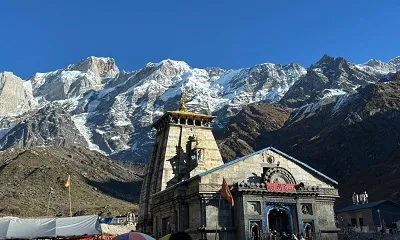
Kedarnath Temple — the most visited of the five, part of the 12 Jyotirlingas and the Char Dham Yatra, set deep in the Garhwal Himalayas.
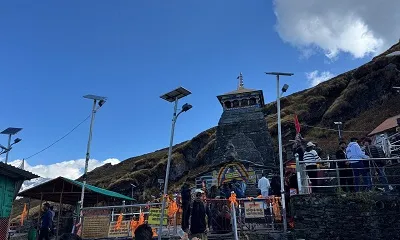
Tungnath Temple — the highest Shiva temple in the world, reached by a short 3.5 km trek from Chopta.
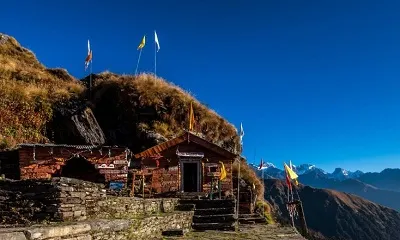
Rudranath Temple — a remote cave shrine in Chamoli district reached via a demanding multi-day trek, considered the toughest of the five to reach.
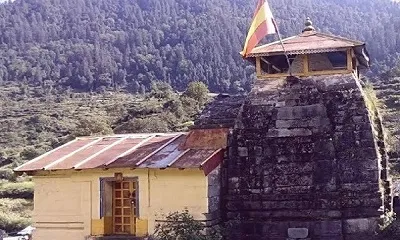
Kalpeshwar Mahadev Temple — the fifth and final Kedar, and the only one open year-round, reached by a short 1 km walk from Urgam village.
Note: For the full mythology and legend behind all five temples, read our All About Panch Kedar Temples guide.
Watch: Madhyamaheshwar Trek
Prefer to see the route before you go? Watch a complete Madhyamaheshwar trek guide on YouTube covering the route, budget, and stay options along the way.
Plan Your Trip: Madhyamaheshwar Trek Itinerary
Most trekkers cover Madhyamaheshwar in 3 days from Ransi. Altitudes are approximate:
| Day | Route | Distance | Notes |
|---|---|---|---|
| Day 1 | Drive to Ransi (about 2,000 m) | about 20 km from Ukhimath | Overnight in a Ransi homestay |
| Day 2 | Ransi → Gaundar (about 2,300 m) → Bantoli (about 2,400 m) → Khatara (about 2,600 m) → Nanu (about 2,800 m) → Madhyamaheshwar (3,497 m) | 16–18 km, 7–9 hours | The last 7 km after Bantoli is a steady climb; to go slower, stay at Bantoli or Khatara and make it a 4-day trip |
| Day 3 | Budha Madhyamaheshwar at sunrise, then trek back to Ransi | about 4 km + 16–18 km | Start around 5 AM; Budha Madhyamaheshwar is weather permitting |
Stay and cost (approximate, 2026): homestays at Ransi cost about ₹500–800 per person per night, with meals about ₹100–150 each. Gaundar, Bantoli and Khatara have basic rooms for about ₹300–800, and homestays and the dharamshala near the temple cost about ₹500–1,500 per bed. Prices rise in peak season, so confirm locally.
Mobile network: BSNL, Jio and Airtel work only patchily at Ransi and Gaundar, and there is usually no network near the temple, so tell your family before you start the trek.
This is the complete experience of my sacred journey to the Madhyamaheshwar Temple Uttarakhand , and guidance for your next journey to the Garhwal region of Uttarakhand.
This Madhyamaheshwar blog is written to create the best memories of your life with my personal experience and guidance on the route, trekking essentials, tips for trekking, best time to visit, and more, including the mythology and history behind it.
I hope this blog helps you throughout your journey. Plan your next journey now with this detailed information.
Frequently Asked Questions
1. What is Madhyamaheshwar famous for?
Madmaheshwar is famous for its deep spiritual significance and mythology behind it. The temple is considered one among the panch kedar circuit, offering a divine and spiritual experience to pilgrims. The serene views of surrounding making it an ideal destination for pilgrims, trekkers, and nature lovers.
2. How long is the Madhyamaheshwar Trek?
The Madhyamaheshwar trek is considered to be 16 to 18 km long from the base camp Ransi, which can be completed in 2 to 3 days . The difficulty level of this trek is moderate, but needs precautions and extra care.
3. What is the history of Madhyamaheshwar Temple?
The sacred legends hold that the Panch Kedar temple was created with different body parts of Lord Shiva, when the strongest Bheem, one of the Pandavas, held the hump of the bull, it took the real form of Lord Shiva and distributed in five parts of Lord Shiva, and one of them was the navel/stomach, which is now worshipped at the Madhyamaheshwar Temple.
4. In which district is Madhyamaheshwar Temple?
Madhyamaheshwar Temple is located in the Rudraprayag district of Uttarakhand, Garhwal Himalayan region. Gaundar village is the nearest settlement directly located along the trekking route to the temple, while Ransi village serves as the primary motorable base village where the trek begins. Here is the Madhyamaheshwar location breakdown:
-
State: Uttarakhand, India
-
District: Rudraprayag
-
Motorable Base Village: Ransi (trek starts here)
-
Nearest Village to the Temple: Gaundar (along the trekking route)
-
Nearest Town: Ukhimath
5. How to visit Madhyamaheshwar Temple?
To reach Madhyamaheshwar Temple, you can start your journey from Ukhimath, a town in Uttarakhand. From there, you have to reach Ransi Village, then you can start the trek to the temple, which is around 16 to 18 km, and takes 2 to 3 days to complete.
6. Is the Madmaheshwar trek difficult?
The Madhyamaheshwar Trek is considered to be moderate, and it can be completed in 2 to 3 days from the Ransi base camp. Because it's relatively short for a Himalayan trek, it's a reasonable choice for newcomers with a base level of fitness. Maintaining an exercise routine is advised at least one month before the trek.
7. Which part of Shiva is in Madmaheshwar?
The Temple is dedicated to Lord Shiva, and the navel (nabhi) and stomach of Lord Shiva are considered to be worshipped at the Madmaheshwar Temple in Uttarakhand. The temple holds the deep mythology behind it. All Panch Kedars have a specific body part of Lord Shiva, and it is one of them.
8. What is the best time to visit Madhyamaheshwar?
The best time to visit is from late May to June and from mid-September to mid-November, when Madhyamaheshwar is open. The weather stays pleasant with clear skies and mild temperatures, ranging from 5°C to 15°C , is ideal for finishing the hike without incident.
9. How far is Madmaheshwar from Rudranath?
Madhyamaheshwar and Rudranath are on different routes. From the temple, walk back 16–18 km to Ransi, drive about 95 km via Ukhimath, Chopta and Gopeshwar to Sagar village, then trek about 20–22 km to Rudranath; covering both usually takes 4–5 days. On the way you pass close to Makkumath Uttarakhand , the winter seat of Tungnath. For Rudranath itself, we run a separate Rudranath trek package from Haridwar and Rishikesh. To cover all five Kedar temples in one trip, see our Panch Kedar Yatra package.10. Is Madhyamaheshwar a Jyotirlinga?
No, Madhyamaheshwar is not a Jyotirlinga. It is one of the Panch Kedar temples, where the middle (navel) part of Lord Shiva is worshipped. Of the Panch Kedar temples, only Kedarnath is also one of the 12 Jyotirlingas.11. Is Madhyamaheshwar open in December?
No. Madhyamaheshwar Temple is closed from 16 November 2026 until late May 2027. In winter, darshan takes place at the Omkareshwar Temple in Ukhimath, which is open all year.12. How far is Kedarnath from Madhyamaheshwar?
From Kedarnath, trek 16 km down to Gaurikund, then drive about 70 km via Sonprayag, Guptkashi and Ukhimath to Ransi, and trek 16–18 km up to Madhyamaheshwar. Allow 2–3 days between the two temples.