Introduction
Adi Badri, a complex of 16 ancient temples, is a sacred site located in the Chamoli district of Uttarakhand, on the confluence of the Alaknanda and Pinder River, near Karanprayag, a town. The temple is renowned as the first Badri among the Sapt Badri temples, dedicated to lord vishnu, and it holds great significance for its unique history and heritage.
It is believed that the Adi Badri temple of Uttarakhand was built during the late Gupta period from 5th-8th century, and it was reestablished by the saint Adi Shankaracharya to revive Hinduism. The temple also serves as the substitute site of the Badrinath temple, which is an integral part of the Char Dham yatra, and the Do Dham yatra of Uttarakhand. Pilgrims visit here when the main Badrinath temple is inaccessible during the winter season. The complete travel guide and tips to travel Adibadri temple are provided in this article.
Quick facts table about Adi Badri Temple
| Attribute | Details |
|---|---|
| Main Deity | Lord Vishnu |
| Location | Badrinath road, near Karanprayag town in the Chamoli district of Uttarakhand. |
| Travel Distance / Time | About 18 km from the nearest town, Karanprayag. |
| Darshan Timings | Morning: 5 a.m. to 1:00 p.m. Evening: 2:00 p.m. to 9:00 p.m. |
| Entry Type | Free |
| Why should you visit? | For spiritual fulfilment and seeking the divine blessings. |
| Exploration Time | Maximum 2 hours. |
History & Mythological Significance of Adi Badri Temple
This beautiful temple holds great Historical and Mythological significance, as part of the Sapt Badri and Panch Badri sacred sites. The History and mythology related to this site are deeply rooted in Hindu mythology and the Garhwal region.
History of Adi Badri Temple
- A historical temple complex:- Adi Badri is a group of 16 temples, not a single temple; 14 shrines still survive from the 16 shrines. It was built near the ancient capital of Chandpur (the former kingdom of Garwal’s Parmar kings).
- Adi Shankaracharya’s contribution:- Some legends state that this site was reconstructed by the 8th-century philosopher, Adi Shankaracharya; his efforts helped in reviving Hinduism throughout India.
- Architectural Significance:- The main temple with a black stone idol of lord vishnu in Adi Badri is built on a raised platform with a pyramidal roof.
Mythological Significance of Adi Badri
- Legend of lord Vishnu:- According to the Hindu beliefs, this site is an ancient abode of Lord Vishnu during the Satya, Treta, and Dwapar yugas, before he relocated to the main Badrinath temple during the present Kalyuga.
- Legend associated with Ved Vyasa:- Some other beliefs say that Sage Ved Vyasa organized the Vedas and also wrote the Shrimad Bhagwat Purana at this sacred spot.
- Origin of Saraswati River: -This site is also considered the origin of the Saraswati River.
Book Your- Kedarnath and Badrinath Yatra Package
Location & Height of Adi Badri Temple
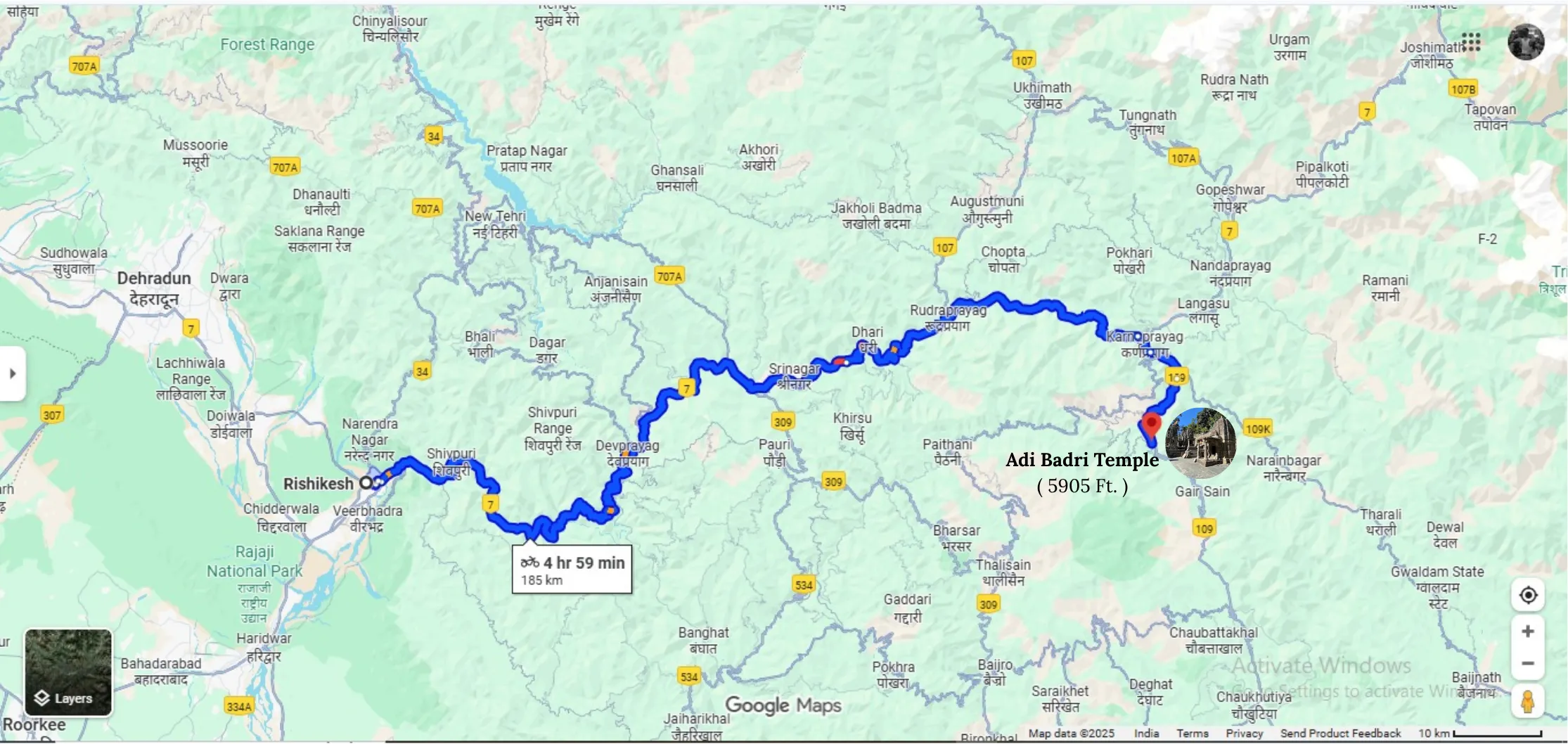
- Location: The Adi Badri temple is located on Badrinath road near Karanprayag (confluence of the Alaknanda and Pindar rivers) in the Chamoli district of Uttarakhand.
- Height: The temple is situated at an elevation of 1,800 meters (5,905 feet) above sea level.
How to Reach Adi Badri
By road via car/taxi or local bus
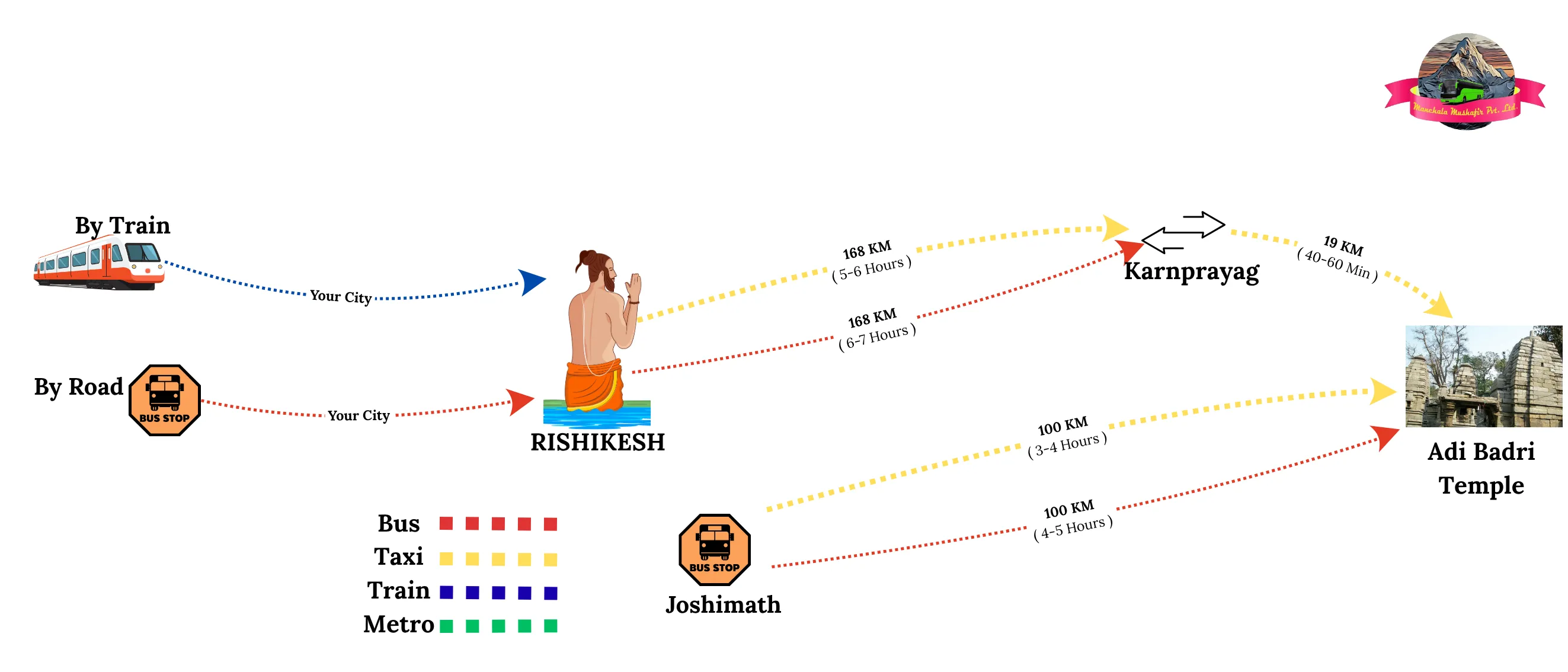
- From Rishikesh: The Distance from Rishikesh to Adi Badri is approximately 187 km by road. You can hire a taxi or local bus from Rishikesh to reach Karanprayag, and from there, take another local transport to reach the Adi Badri temple. The NH-7 route, which connects to NH-109, is followed for this journey.
- From Joshimath: Joshimath is a holy town, located on the route to the Badrinath temple. Adi Badri is 100 km from Joshimath by road. You can cover this distance by private car or taxi, which takes 3 to 4 hours. The complex of Adi Badri is 18 km from Karanprayag.
- By Trek or shuttle walk: The temple is also accessible by a shuttle walk from Karanparay, as the roads are well-maintained and surrounded by the picturesque hills. To reach the Kedarnath temple by trek, firstly, you will need to travel to Karanprayag via car, taxi or bus. From there, you can head on a trek to reach the temple’s complex.
Generally, the NH-7 route is followed for this journey. From Karanprayag, take the road towards Ranikhet, as the temple is located on this road.
If you are willing to visit here, you can also club it with do Dham Yatra. You can contact our customer care executive and get this location clubbed into your Do dham yatra package for a fulfilling travel experience.
Adi Badri Temple Distance from Major Cities
| From City | Distance (Approx.) |
|---|---|
| Karnaprayag | 18 km |
| Dehradun | 225 km |
| Rishikesh | 190 km |
| Haridwar | 212 km |
| Delhi | 446 km |
Weather & Best Time to Visit Adi Badri Temple
As we know, the temple is located in the remote region of the Himalayas at a very high altitude, which experiences distinct weather in distinct seasons. During the summer, the region experiences pleasant and cool weather with mild temperatures and during the monsoon, expected to experience moderate rainfall, and the entire region, including the temple, becomes inaccessible due to harsh weather and heavy snowfall. Here is the detain in breakdown on weather and the best months to visit the Adi Badri temple.
Summer Season (May-June): During the summer months, the weather is pleasant with clear skies and mild temperatures, considered the peak season for pilgrims and travellers.
- Temperature: moderate, ranging from 15°C to 25 c.
- Conditions: warm days but cooler nights, clear skies and lush greenery scenes, making it an ideal time for
Monsoon Season (July-August): monsoon is marked by heavy rainfall, which leads to landslides, road blockages, thunderstorms and floods, making it avoidable.
- Temperature: from 15°C to 20°C
- Conditions: high humidity, slippery paths and poor visibility, making travel difficult or impossible at this time.
Autumn Season (Sep-Oct): The rain retreats after the monsoon in September, and the weather becomes pleasant with clear skies and visibility.
- Temperature: comfortable, ranging from 10°C to 20°C.
- Conditions: Days are warm and crisp with humidity and moisture; this period offers excellent visibility of the surrounding Himalayan scenery, making it another ideal time to visit.
Winter season (Nov-Apr): The region experiences extremely harsh weather with heavy snowfall, making travel inaccessible at this time.
- Temperature: drops to sub-zero, especially at night.
- Conditions: heavy snowfall leads to thunderstorms, making travel impossible during the winter periods.
| Season | Months | Temperature Range | Conditions | Travel Feasibility |
|---|---|---|---|---|
| Summer | May – June | 15°C – 25°C | Pleasant; warm days, cooler nights, clear skies, lush greenery. | Peak season — ideal ✅ |
| Monsoon | July – August | 15°C – 20°C | Heavy rain, landslides, slippery paths, and poor visibility. | Avoidable — travel difficult ❌ |
| Autumn | September – October | 10°C – 20°C | Clear skies, crisp days, excellent Himalayan views. | Ideal time to visit ✅ |
| Winter | November – April | Sub-zero (esp. nights) | Heavy snowfall, roadblocks, and extremely harsh conditions. | Inaccessible — avoid ❌ |
Recommended visits months:- May to June and September to October are considered the best months to visit Adi Badri, as these periods offer pleasant weather with moderate temperatures and clear skies and clear visibility. These conditions make it the best time to visit.
Tips for Monsoon and Winter visit:
Monsoon and Winter are considered off-season, as monsoon experiences heavy rain and winter experiences cold weather with moderate snowfall, making travel tricky or impossible during these periods. But if you decide to visit during this period, here are some tips to ensure safe travel.
- Check the road conditions and weather first.
- Prepare yourself for any delays
- Carry all the clothing essentials, including rainy and winter gear.
- Stay connected and informed, especially if you plan to go solo.
Adi Badri Temple’s Nearby Attractions and pilgrimage circuits
Adi Badri, the first of the Panch Badri pilgrimage circuits (located in the Badri Kshetra in Uttarakhand), is a key pilgrimage site for pilgrims and adventurous travellers who are on their route to the Badrinath temple or in the nearby areas.
Panch Badri Pilgrimage circuits—Adi Badri and the other four, including Badrinath (Vishal Badri), Yogdhayan Badri (in Pandukeshwar), Bhavishaya Badri and Vridh Badri—are five sacred sites dedicated to Lord Vishnu and located in Joshimath town, accessible by road travel.
Vasundhara Falls: A 400-foot cascading waterfall, located in the Badrinath valley, near the Badrinath temple. Vasudhara Fall is renowned for its stunning natural beauty and great significance; it is believed that the water of this wonder falls only on virtuous people, and it turns away from sinners. This site is accessible by a 6 km trek from Mana village, near the Badrinath temple.
Karanprayag: A sacred site, located 18 km from Adi Badri temple at the confluence of the Alaknanda and Pindar rivers and part of Panch Prayags (sacred confluences of holy rivers).
Bhavishya Badri Temple Trek: one of the Panch Badri circuit, located near Joshimath, where lord vishnu is believed to be worshipped in future. The temple is situated at an altitude of 9,003 feet above sea level, and it holds great mythological significance. The temple is accessible by a 6 km moderate trek, which is surrounded by dense oak forest and lush green valley, offering breathtaking views of the Himalayas.
Chopta-Tunganath Trek: located in the Chamoli district of Uttarakhand on the route to Badrinath temple. Chopta, renowned for its alpine lush meadows and surrounding beauty, serves as a base camp for the World’s Highest Shiva Temple, Tungnath (situated at an elevation of 12,073 feet). The chopta to Tungnath distance is of 3.5 kms, which offers 360-degree views of the Himalayan peaks such as Chaukhand and Nanda Devi. So, in addition to being a pilgrimage hotspot, this place is also well known for the Chopta Tungnath trek.
Valley of Flowers: A UNESCO World Heritage site, located in the Chamoli district of Uttarakhad, Valley of Flowers trek is one of the best trekking destinations of India. This valley is known as one of the popular trekking sites in Uttarakhand, renowned for its alpine meadows and diverse flora and fauna. The trek to the valley starts from Govindghat, near Joshimath town, accessible by road via taxi or bus. Cascading waterfalls, diverse wildlife, alpine, and the flow of the Pushpawati River are the main highlights of the trek. Here you can also visit to the highest gurudwara of India, i.e. Hemkund Sahib Gurudwara.
Travel
Tips & Information
- Accommodation options: Accommodations are primarily found in Karanprayag town, which offers basic hotels to luxurious resorts. It is advisable to book your hotels in advance if you plan to visit during peak season.
- Carry Essentials: Packing is a crucial part of your journey, so pack wisely. Carry all the essential things, including clothing, a medical kit, footwear, documents, cash and other items.
- Permits: There is no permit required to visit the Adi Badri temple. But if you want to travel to nearby trekking sites, like Valley of Flowers and Vasudhara Falls, a permit is required for that, as these sites pass through the deep forest.
- Check the Best time to visit: Check the weather and be aware of the road conditions before planning for a trip. Peak summer and the post-monsoon season are the best times to visit adi badri, as these seasons offer favourable weather conditions.
- Safety Advice: Stay hydrated throughout your whole journey, and don’t travel after sunset to ensure a safe and smooth journey.
FAQs
Is Adi Badri accessible in winter?
Yes, the temple is accessible in winter, but it experiences harsh and cold weather. The entire region is covered with snow, making it difficult to navigate the mountain roads. It is advisable to avoid visiting during the winter, as snowy paths affect accessibility.
How far is Adi Badri from Joshimath?
The Adi Badri Temple is approximately 99 km from Joshimath by road. The distance you can cover by taxi or jeep, which takes 3 to 4 hours to complete, depending on the chosen road and traffic.
What is the distance from Adi Badri to Rishikesh?
The road distance between Rishikesh and Adi Badri is 190 km. You can hire a private taxi or local bus from Rishikesh to reach Karanaprayag, which takes 5-6 hours. From there, you can take a shared taxi or walk to reach the temple’s complex.
What are the darshan timings of the temple?
Generally, the temple is open from 05.00 a.m. to 12.00 p.m. in the morning and 2.00 p.m. to 9.00 p.m. for daily darshan. The pilgrimage season starts from Makar Sakranti, which is held in January and ends in November due to cold and harsh weather.
Are any fees or permits required to visit Adi Badri?
No, there is no entry fee to visit Adi Badri, darshans are free for the general public. Also, there is no permit required to visit Adi Badri, but certain documents, like the Aadhaar card, are necessary to travel in this region and for accommodation booking.
Conclusion
Adi Badri, the first stop of the five sacred pilgrimage sites, is dedicated to lord vishnu, located in the Chamoli district of Uttarakhand. The temple holds huge mythological significance; it was built in the late Gupta period and is renowned as the permanent abode of Lord Vishnu. The temple is not a single temple, but it is a cluster of 16 ancient temples, of which 14 remain. The rich history and significance attract the travellers most. Many travellers visit this temple to enrich their spiritual experience, especially when the main Badri temple is inaccessible during the winter closure. Here are some things to consider, including weather, accessibility, accommodations and the best time to visit, to assure a safe and memorable journey.