Best Time to Visit Triyuginarayan Temple 2026
Category: Travel | Updated On: August 1, 2026 | Published: November 16, 2025

Triyuginarayan Temple is open all year round. Unlike Kedarnath, it does not close for winter. The best months to visit are April to June and September to November, when roads are clear and skies are open. December to February brings snow and temperatures of 2–10°C by day, below freezing at night. Avoid July and August — heavy monsoon rain triggers landslides on the Sonprayag road.
Triyuginarayan Temple is a sacred Hindu pilgrimage site in the Rudraprayag district of Uttarakhand, at an altitude of around 1,980 metres (6,497 feet), surrounded by Himalayan peaks. It is believed to be the wedding site of Lord Shiva and Goddess Parvati and is home to the Akhand Dhuni, a fire said to have burned continuously since that divine marriage.
This guide covers the temple's weather, temperature and crowd levels month by month, so you can pick a time based on what actually matters to you — clear roads, fewer crowds, or snow — rather than a single generic "season."
Quick Answer: When to Go
- Best overall: April to June and September to November. Roads are clear, skies are open, and this is the widest window of good travel weather all year.
- Best for families: May and June — the temperature is moderate, rainfall is minimal, and you can often spot snow-capped peaks from the temple itself. Expect larger crowds once the Kedarnath Yatra season opens in May.
- Best for fewer crowds with good weather: late September through November, once monsoon clears.
- Avoid: July and August. Heavy monsoon rain brings landslide risk and slippery trails on the Sonprayag–Gaurikund road.
- Want snow instead of crowds: December to February is cold and quiet, with the region's heaviest snowfall. See the snowfall section below before you plan a winter trip.
Is Triyuginarayan Temple Open All Year?
Yes. Triyuginarayan Temple is open every day of the year. It does not have a winter closure or a fixed reopening date the way Kedarnath does.
Why People Think It Closes in Winter
The confusion is understandable. Kedarnath, a short distance away up the valley (see the Triyuginarayan distance chart for the exact route), is a high-altitude shrine that closes around Bhai Dooj in November and reopens around Akshaya Tritiya in April or May, once the Char Dham winter closure ends. Several travel sites apply that same seasonal calendar to Triyuginarayan without checking — but Triyuginarayan is a village temple at 1,980 m, well below the snowline that forces Kedarnath to shut, and its priests and the village around it stay through winter. The temple remains open; only the volume of visitors drops.
Darshan Timings
The temple opens at 6:00 AM and closes around 8:00 PM, with a roughly one-hour afternoon break. Other travel sites publish different figures for this temple — some list a single continuous 6 AM to 7 PM window, others a different split — and none of them, including this one, are independently confirmed with the temple committee. Treat all published timings, ours included, as a guide rather than a guarantee, and check locally if your visit depends on a specific hour.
| Activity | Time |
|---|---|
| Temple opens | 6:00 AM |
| Morning darshan & puja | 6:00 AM – 12:00 PM |
| Bhog (offering) | 12:00 PM – 1:00 PM |
| Afternoon break (temple closed) | 1:00 PM – 2:00 PM |
| Afternoon darshan | 2:00 PM – 6:30 PM |
| Evening aarti | 6:30 PM – 7:30 PM |
| Temple closes | Around 8:00 PM |
Timings can shift slightly during festivals and major ceremonies like Mahashivratri — arrive early on those dates.
Triyuginarayan Temple Month by Month
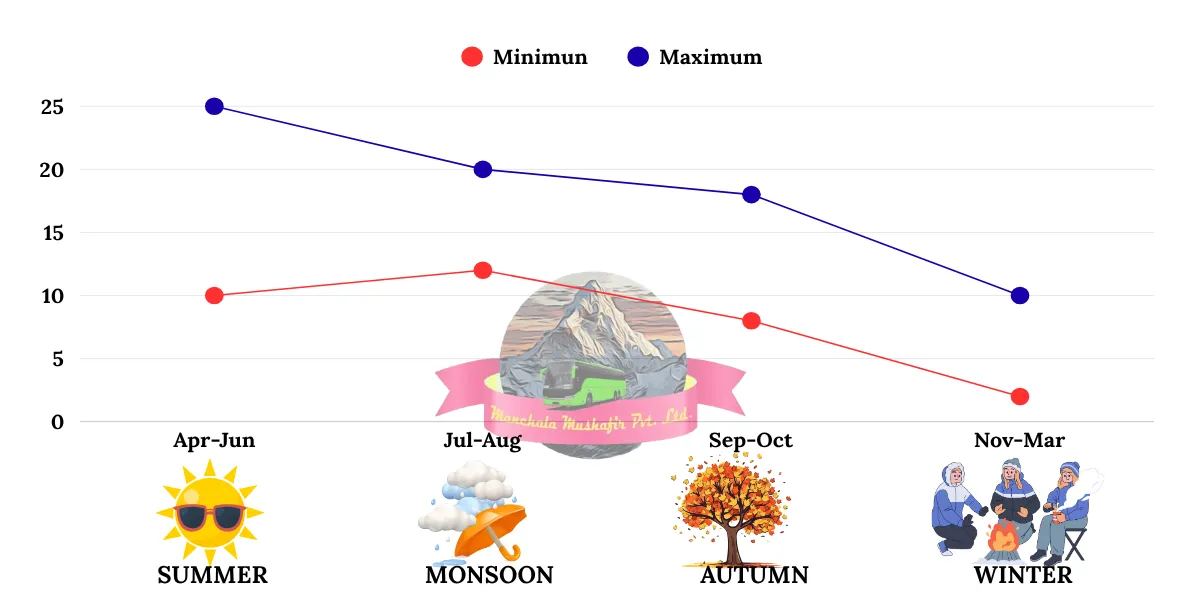
| Month | Avg High (°C) | Avg Low (°C) | Rainfall | Snow | Crowd | Verdict |
|---|---|---|---|---|---|---|
| January | 8 | 2 | Minimal | Heavy | Very low | Not ideal |
| February | 10 | 4 | Minimal | Moderate | Very low | Not ideal |
| March | 12 | 6 | Light | Melting | Low | Limited |
| April | 15 | 8 | Light | None | Moderate | Good |
| May | 18 | 10 | Light | None | High | Best |
| June | 22 | 12 | Light–Moderate | None | High | Best |
| July | 20 | 10 | Heavy | None | Low | Avoid |
| August | 19 | 10 | Heavy | None | Very low | Avoid |
| September | 20 | 8 | Moderate, clearing mid-month | None | Moderate | Good, best after mid-Sept |
| October | 16 | 6 | Minimal | None | Moderate | Best |
| November | 12 | 4 | Minimal | Occasional | Low | Good |
| December | 8 | 3 | Minimal | Heavy | Very low | Not ideal |
January – Deep Winter, Heaviest Snow
Triyuginarayan Temple stays open in January, but this is the coldest month of the year. Daytime temperatures run 2–8°C, dropping below freezing after dark. Snow is close to guaranteed, usually already on the ground from December and topped up by fresh falls through the month. The Sonprayag–Gaurikund road stays open in normal conditions and chains are not typically required for cars, but fresh snowfall can close it for a day or two until it's cleared, so build a spare day into any January trip. Crowds are at their lowest of the year. Verdict: only for travellers who specifically want snow and solitude, not for a first visit.
February – Snow, Clear Skies, Fewest Crowds
Triyuginarayan Temple is open in February, and snow is common, though usually lighter than January's. Daytime highs reach 4–10°C with clear skies between snowfalls, which makes for some of the best mountain visibility of the year on a good day. Nights are still well below freezing. This is the quietest month for visitors and roads are generally passable, weather permitting. Verdict: a strong month for photography and solitude if you don't mind the cold.
March – Snow Melts, Season Begins
By March, snow starts melting at lower elevations and temperatures climb to 6–12°C during the day. Roads clear up as the month goes on, though early March can still see leftover snow and slush near Sonprayag. Crowds remain low. Verdict: a transitional month — the back half of March is noticeably easier travel than the front half.
April – Season Opens, Green Valley
April brings the start of the main travel season, with temperatures of 8–15°C, clear roads and a valley turning green as the last snow melts. This is also when the Kedarnath Yatra season typically opens, so pilgrim traffic through the region starts to build, though Triyuginarayan itself stays comfortably uncrowded compared to May and June. Verdict: one of the best months of the year, and quieter than the peak that follows it.
May – Peak Season, Kedarnath Yatra Begins
May is one of the two most popular months to visit, with pleasant temperatures of 10–18°C and clear skies. The Kedarnath Yatra is in full swing by now, and many pilgrims combine both temples in one trip, which means larger crowds and busier roads than April. Verdict: excellent weather, but expect company — book accommodation ahead.
June – Warmest Month, Busiest Roads
June is the warmest month of the year at Triyuginarayan, with highs reaching 22°C and mild, sunny days. It's also the busiest month on the roads, as peak Char Dham season overlaps with school summer holidays. Verdict: reliably good weather, but plan for traffic and crowded accommodation, especially closer to the last week of the month as monsoon approaches.
July – Monsoon Arrives, Landslide Risk
Monsoon sets in through July, bringing regular rain, mist and temperatures of 10–20°C. The Sonprayag–Gaurikund stretch is prone to landslides in heavy rain, and trails around the temple get slippery and muddy. Crowds thin out considerably. Verdict: avoid unless your travel dates are fixed — check road conditions closely before setting out.
August – Heaviest Rain, Travel Not Advised
August typically brings the heaviest rainfall of the year, with temperatures of 10–19°C and the highest landslide risk on hill roads in the region. Visitor numbers drop to near their lowest. Verdict: avoid travel this month if you have flexibility on dates.
September – Rain Tapers Mid-Month
September is a split month. The first half is still monsoon, with rain continuing at similar intensity to August and temperatures of 8–20°C. By roughly the middle of the month, rain tapers off, skies clear, and the region enters one of its best windows of the year for the remaining two weeks. Verdict: avoid the first half if you can; the second half rivals October for the best conditions of the year.
October – Clearest Skies of the Year
October offers some of the clearest skies and best mountain visibility of the year, with comfortable temperatures of 6–16°C and minimal rainfall. Crowds are moderate — lighter than May or June, busier than the winter months. Verdict: one of the two best months to visit, alongside late September. Clear October days are also a good time to explore the wider area — see our guide to places to visit near Triyuginarayan.
November – Cold, Quiet, Excellent Visibility
Triyuginarayan Temple is open in November. Temperatures cool to 4–12°C, occasional early snow is possible by late in the month, and skies stay largely clear. Crowds drop off as the main pilgrimage season winds down elsewhere in the region. Verdict: a genuinely good month that gets overlooked — clear weather without the peak-season crowds.
December – First Heavy Snow, Very Cold
Triyuginarayan Temple is open in December, though this is where winter properly sets in. Daytime temperatures run 3–8°C and fall below freezing at night, with the first heavy snowfall of the season typically arriving by mid-to-late month. The Sonprayag–Gaurikund road generally stays open between snowfalls but can close temporarily right after a heavy fall. Crowds are very low. Verdict: only for travellers specifically seeking a winter, snow-covered visit — confirm road conditions before you set out.
Snowfall at Triyuginarayan: What to Expect
Snow is most likely from December through February, with occasional early or late falls in November and March. January and February typically see the heaviest accumulation. Snow settles on the temple courtyard and the surrounding village, and the Akhand Dhuni's shelter keeps the flame itself protected even when there is snow outside. Fresh, heavy snowfall can close the Sonprayag–Gaurikund road temporarily, usually for a day or two until it's cleared — if you're travelling in this window, build spare time into your itinerary and check road status close to your travel date rather than assuming it will be clear.
How Weather Affects Access to the Temple

Weather is the main variable that affects how easily you can reach Triyuginarayan Temple, since the final approach runs along hill roads that are sensitive to both monsoon rain and winter snow.
When the Road Is Affected
Impact: Heavy monsoon rain triggers landslides and makes the Sonprayag–Gaurikund stretch slippery and muddy; see July and August for specifics.
Accessibility: Travel is risky and not recommended during active heavy rain. If your dates are fixed, check road conditions the morning of travel.
When the Trek Is Affected
Impact: Fresh snowfall and sub-zero night temperatures make roads and trails slippery, particularly right after a heavy fall; see December and January for specifics.
Accessibility: The temple stays open and roads are generally passable between snowfalls, but expect a quieter, slower trip.
For the full road-by-road breakdown of how to actually get here — by bus, train, taxi or self-drive — see our guide on how to reach Triyuginarayan Temple. For exact road distances from Delhi, Haridwar, Rishikesh and Kedarnath, see the Triyuginarayan distance chart.
Festivals and Occasions
Triyuginarayan Temple is not only a sacred pilgrimage site but also an important cultural destination where several religious festivals and occasions are celebrated throughout the year.
Mahashivratri (February)
Mahashivratri is one of the most significant festivals celebrated at Triyuginarayan Temple, commemorating the divine wedding of Lord Shiva and Goddess Parvati. Special pujas, rituals and devotional gatherings are held, though weather conditions remain cold during this time.
Akhand Dhuni Puja
The Akhand Dhuni, the eternal sacred fire believed to be burning since the marriage of Lord Shiva and Goddess Parvati, is a major spiritual highlight of the temple. Special prayers and offerings are performed during peak pilgrimage months, attracting devotees seeking blessings and spiritual peace.
Shravan Month (July–August)
The holy month of Shravan is dedicated to Lord Shiva and holds great religious importance, with special pujas, bhajans and chanting rituals. Shravan coincides with the monsoon, so travellers attending should be cautious of rainfall and road conditions.
Weddings
Triyuginarayan is also known as a traditional Hindu wedding site, since it is the mythological marriage place of Shiva and Parvati.
What to Pack, by Season

Here are the essentials to pack for a trip to Triyuginarayan Temple, depending on when you're travelling:
- Warm clothes: fleece jackets, sweaters and winter accessories — essential November through March, useful even in the evenings from April and September.
- Rain gear: umbrella and poncho, essential for July, August and early September.
- Trekking gear: trekking shoes with good grip and a walking stick, useful year-round on the local trails.
- Medical kit: a small kit with prescribed medicines, painkillers and bandages.
- Other essentials: flashlight, power bank, water bottles and a sturdy backpack.
- Hydration and nutrition: dry fruits and glucose sachets for quick energy on longer travel days.
Final Thoughts
Weather at Triyuginarayan changes significantly through the year, and each season offers a different experience — from the green valleys of April to the snow-covered courtyard of January. April to June and September to November give the most reliable combination of clear weather and open roads, while December to February rewards travellers who specifically want snow and quiet over easy travel. Whichever season you choose, the temple itself is open and waiting — plan around the weather, not around when you think it might be closed.
Frequently Asked Questions
Popular Packages