
About Kedarnath Temple
Kedarnath Temple is one of the most sacred Hindu shrines dedicated to Lord Shiva and is widely revered as one of the 12 Jyotirlingas of India. Located in the Rudraprayag district of Uttarakhand, the temple stands at an altitude of 3,583 meters (11,755 feet) above sea level, on the banks of the Mandakini River in the Garhwal Himalayas.
Uttarakhand is often known as Dev Bhoomi (Land of the Gods) because of its deep spiritual heritage and thousands of ancient temples spread across the state. Among them, Kedarnath holds special prominence due to its religious importance and breathtaking Himalayan setting. The shrine is surrounded by snow-capped peaks on three sides, with a deep valley opening in front, creating a spiritually powerful and visually magnificent landscape.
Kedarnath Temple forms an integral part of the Panch Kedar, Do Dham Yatra, and the sacred Char Dham Yatra of Uttarakhand. According to Hindu scriptures, the temple was originally established by the Pandavas after the Kurukshetra war. It is believed that the hump of Lord Shiva, who appeared in the form of a bull (Nandi), is worshipped here as the primary deity.
Kedarnath Temple History
The history of Kedarnath Temple is deeply rooted in Hindu mythology and the epic Mahabharata. According to sacred scriptures, the temple is closely associated with the Pandavas of the Kuru clan, who sought forgiveness from Lord Shiva after the devastating Kurukshetra war.
After defeating the Kauravas and reclaiming their kingdom of Hastinapur under the guidance of Lord Krishna, the Pandavas were filled with remorse for the loss of lives in the battle. Seeking moksha (liberation) and relief from their sins, they were advised to pray to Lord Shiva. However, Lord Shiva was displeased with the violence of the war and decided to avoid them.
To escape the Pandavas, Shiva is believed to have disguised himself as a bull (Nandi) and hidden in the Himalayan region of Guptkashi. Determined to find him, the Pandavas followed him to the village of Kedar. When Bhima recognized the bull as Lord Shiva, he tried to hold it, but the deity disappeared into the earth.
It is believed that different parts of the bull’s body reappeared at five separate locations in the Himalayas. These sacred sites later became known as the Panch Kedar temples:
- The hump appeared at Kedarnath
- The arms at Tungnath Temple
- The face at Rudranath Temple
- The stomach at Madhyamaheshwar Temple
- The hair at Kalpeshwar Temple
Historically, it is also believed that the present stone structure of Kedarnath Temple was revived and re-established in the 8th century by Adi Shankaracharya, strengthening its importance as a major Jyotirlinga shrine in India.
Kedarnath Temple Opening and Closing Date 2026
The opening and closing dates of Kedarnath Temple are officially announced every year by the temple authorities at Ukhimath on the auspicious occasion of Maha Shivratri.
For 2026, the Kedarnath Temple will open on 22 April 2026 on the holy occasion of Akshaya Tritiya. The temple generally remains open for six months and closes around Bhai Dooj (October/November), before the onset of heavy snowfall in the region.
The exact closing date for 2026 will be declared on Vijayadashami as per traditional rituals.
For detailed updates, rituals, and complete schedule, read our dedicated guide on Kedarnath Temple Opening and Closing Dates 2026.
Best Time to Visit Kedarnath Temple

The best time to visit Kedarnath Temple is between May and June and September to October, when the temple remains open for pilgrims. Due to extreme winter snowfall, the shrine is accessible only for about six months each year.
May to June (Peak Season)
This is the most popular time for the Kedarnath Yatra. The weather remains relatively pleasant, making trekking conditions comfortable. However, since it coincides with the Char Dham Yatra season, pilgrims may experience heavy crowds and higher accommodation costs.
September to October (Post-Monsoon Season)
These months are ideal for travelers seeking a peaceful and less crowded experience. The skies are usually clear, and the Himalayan views are breathtaking. However, temperatures can drop significantly at night, sometimes reaching below freezing levels.
Avoid July and August
The monsoon season brings heavy rainfall, increasing the risk of landslides, road blockages, and travel disruptions. For safety reasons, it is generally not recommended to plan a trip during these months.
For a detailed month-wise weather breakdown and travel advice, read our complete guide on Best Time to Visit Kedarnath.
Essential Items to Carry for Kedarnath Temple Visit

Since Kedarnath Temple is located at a high altitude and requires a 16 km trek from Gaurikund, carrying the right essentials is important for a safe journey.
- Waterproof trekking shoes
- Raincoat or poncho
- Valid ID proof and registration slip
- Basic medicines and first-aid kit
- Reusable water bottle and light snacks
- Power bank and flashlight
Top Places To Visit Near Kedarnath Temple
Apart from its spiritual importance, Kedarnath Temple is surrounded by several scenic and religious attractions in the Garhwal Himalayas. After darshan, visitors can explore these nearby places that offer a mix of spirituality, history, and natural beauty.
1. Bhairavnath Temple (500 meters)
2. Gandhi Sarovar (3 km)
Also known as Chorabari Lake, this glacial lake is accessible via a short trek. The crystal-clear water reflects the surrounding Himalayan peaks, making it a peaceful and photogenic spot.
3. Shankaracharya Samadhi
Shankaracharya Samadhi is located near the Kedarnath Temple. It is the final resting place of Adi Shankaracharya, a famous saint who played a big role in spreading Hinduism. This spot is calm and perfect for people who want to feel connected to history and spirituality.
4. Vasuki Tal
Vasuki Tal is a high-altitude lake about 8 km from Kedarnath Temple. The trek to Vasuki Tal is a bit challenging, but the beauty of the place makes it worth the effort. The lake is surrounded by tall mountains and offers stunning views of the Himalayas.
5. Gaurikund
Gaurikund is about 14 km from Kedarnath Temple and is the starting point of the trek to the temple. It has hot water springs where pilgrims take a holy dip before beginning their journey. Gaurikund is also linked to the story of Goddess Parvati meditating here to win Lord Shiva’s love.
6. Sonprayag
Sonprayag is a small town around 20 km from the Kedarnath Temple. It is where the Mandakini and Basuki rivers meet. The place is quiet and surrounded by beautiful views of mountains, making it a great stop on your way to Kedarnath.
7. Triyuginarayan Temple
Triyuginarayan Temple is about 25 km from Kedarnath. It is believed to be the place where Lord Shiva and Goddess Parvati got married. It is also known as The Universe's First Love Marriage. The temple has an eternal flame that has been burning for centuries. The temple is surrounded by greenery and is a very peaceful spot.
8. Guptkashi temple
Guptkashi temple is 46 km from Kedarnath and is famous for its ancient temples, like the Vishwanath Temple and Ardhnarishwar Temple. The town also offers wonderful views of the Chaukhamba peaks.
9. Chopta
Chopta, about 70 km from Kedarnath, is called the Mini Switzerland of India. It is a scenic hill station with green meadows and snowy mountains. In addition to being a hill station, this place is also known for adventure activities and bird watching. One of the prominent adventure activities of this region is the Chopta Tungnath Trek, which is a small trek of 3.5 km from Chopta that leads to the highest Shiva temple on earth, i.e., the Tungnath temple.
10. Ukhimath Temple
Ukhimath Temple is 41 km from Kedarnath and is the winter home of Lord Kedarnath. When the Kedarnath Temple closes during winter, the idols are moved to Ukhimath for worship. The town is quiet and surrounded by beautiful views of the Himalayas. These attractions near Kedarnath Temple add more meaning and beauty to your trip. Whether you are a nature lover, a history fan, or a spiritual seeker, these places will make your journey unforgettable.
How to Reach Kedarnath Temple
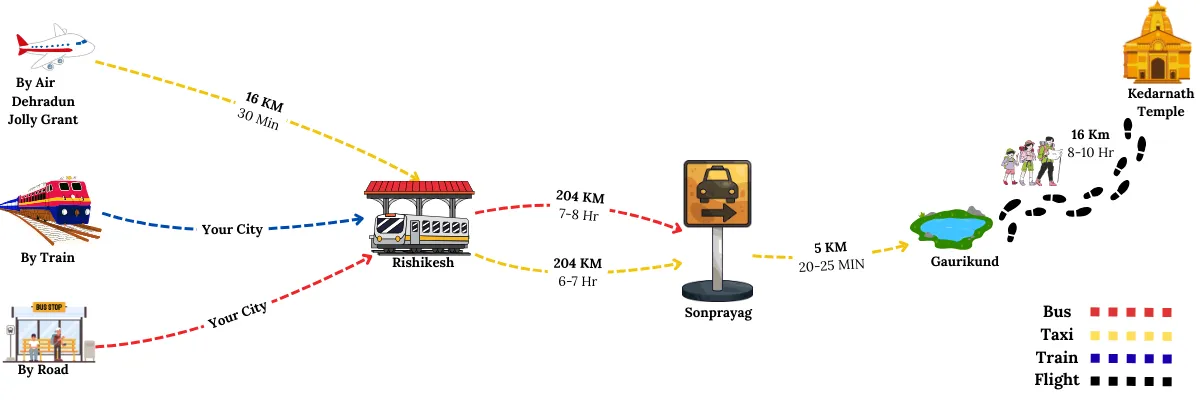
Reaching Kedarnath Temple requires a combination of air, rail, and road travel, followed by a 16 km trek from Gaurikund. Since the temple is located in the high Himalayas of Uttarakhand, proper planning is essential.
1. By Air
The nearest airport is Jolly Grant Airport, located approximately 250 km from Kedarnath. From the airport, travelers can hire a taxi or take a bus to reach Gaurikund, which is the last motorable point.
2. By Train
The nearest railway stations are:
- Rishikesh (approx. 230 km)
- Haridwar
- Dehradun
3. By Road
Gaurikund is the last motorable point before Kedarnath. You can drive to Gaurikund or take state-run or private buses from major cities like Haridwar, Rishikesh, and Dehradun. Taxis are also available. Bus Routes
Regular buses connect Haridwar, Rishikesh, and other towns in Uttarakhand to Gaurikund. The journey offers beautiful views of mountains and rivers.
City-Wise Travel Guides
- How to Reach Kedarnath from Haridwar and Rishikesh
- How to Reach Kedarnath from Delhi
- Mumbai to Kedarnath Complete Travel Guide
Kedarnath Temple Registration
- Name and personal details
- Valid mobile number and email ID
- Government-issued ID proof
- Passport-size photograph
After successful registration, it is mandatory to carry a printed or digital copy of the registration slip during the journey. Registration is also required for those booking helicopter services.
Amazing Facts About Kedarnath Temple
1. Kedarnath temple is part of the 12 Jyotirlingas of India.
2. The Kedarnath trek is more than 16 km in distance, with its base camp located in Guptkashi.
3. Kedarnath temple's history says that it stayed under the ice for 400 years during the mini Ice Age.
4. The current building of the Kedarnath temple is said to have been built in the 8th century and has withstood many floods and natural calamities.
5. The Kedarnath temple was not at all mentioned in the epic Mahabharata. The Skanda Purana is the religious text that talks about the Kedarnath temple for the first time.
6. The Shiva Lingam at the temple has a unique conical shape, which explains the fact that the hump of the bull appeared at this place.
7. This temple was later reconstituted by the prodigy Adi Shankaracharya. The place where he took the Moksha lies near the temple. The site is called Shankaracharya Samadhi.
8. Kedarnath temple remained unscathed in the dangerous flood that happened in 2013 in Uttarakhand. Many people died, and many went missing. Later, the rescue team transported those who had sought safety to a safe location. A huge rock that was carried along with the flood guarded the temple by changing the direction of the flood waters.
9. The rock is called Bhim Shila, and it is also worshipped by the visiting pilgrims because, according to experts, the rock was cut out in perfect measurements to protect the temple structure. The stone is called the armour that is designed by the Almighty Himself to protect the shrine.
10. There is also the existence of another temple called the Bhairavnath temple, which is given the tag of the guardian that protects the Kedarnath from demons.
Plan Your Kedarnath Journey
If you are planning a comfortable and well-organized trip to Kedarnath Temple, you may consider exploring guided travel options that include transportation, accommodation, meals, and registration assistance.
For detailed itineraries and customized travel plans, visit our dedicated page on Kedarnath Tour Packages.
FAQs About Kedarnath Temple
Q1: Where is Kedarnath Temple located?
Kedarnath Temple is located in the Rudraprayag district of Uttarakhand, India, at an altitude of 3,583 meters (11,755 feet) above sea level. It stands near the Mandakini River in the Garhwal Himalayas and is part of the Char Dham pilgrimage circuit.
Q2: Why is the Shiva Kedarnath Temple so famous?
Kedarnath Temple is famous for being one of the 12 Jyotirlingas of Lord Shiva and a key shrine in the Char Dham Yatra. Its high-altitude Himalayan location and deep mythological connection to the Pandavas make it one of the most sacred pilgrimage sites in India.
Q3: How old is Kedarnath Temple?
Kedarnath Temple is believed to date back to ancient times and is associated with the Mahabharata era. The present stone structure was revived in the 8th century by Adi Shankaracharya, making it over 1,200 years old in its current form.
Q4: Who built Kedarnath Temple?
According to Hindu mythology, the temple was originally built by the Pandavas. Historically, it was later restored and re-established by Adi Shankaracharya in the 8th century to revive pilgrimage traditions in the Himalayas.
Q5: What is inside Kedarnath Temple?
Inside Kedarnath Temple, devotees worship a unique conical-shaped Shiva Lingam, which represents the hump of Lord Shiva in bull form. The temple interior is simple, stone-built, and spiritually serene, reflecting ancient Himalayan temple architecture.


.webp?v=245b8d967251c959c4791e56a6d43cb2)