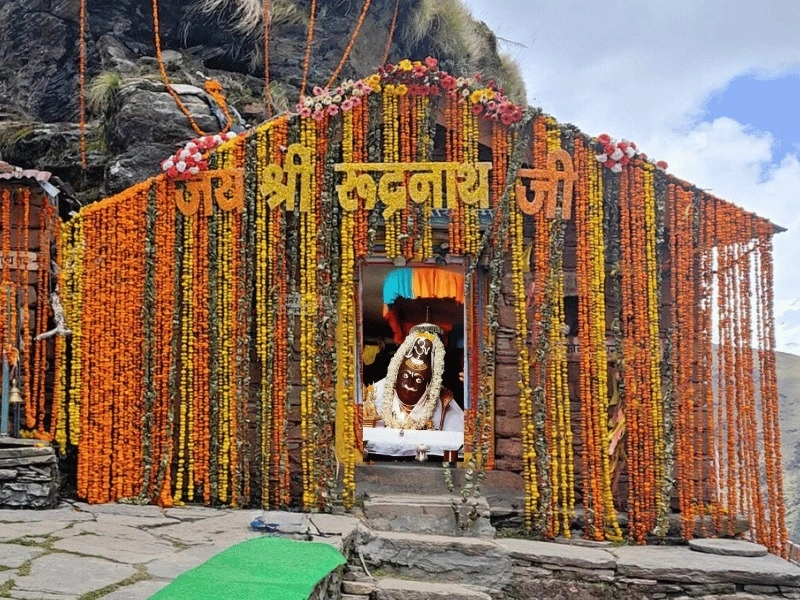
Rudranath Temple Uttarakhand – Introduction
Rudranath Temple is one of the sacred Panch Kedar temples dedicated to Lord Shiva, located in the Chamoli district of Uttarakhand.
The temple is famous for worshipping the face form of Lord Shiva, known as Neelkanth Mahadev.
The Rudranath altitude is approximately 3,600 meters (11,800 feet) above sea level, making it one of the highest and most spiritually significant shrines in the Garhwal Himalayas.
The Rudranath height and location amidst dense alpine forests and high mountain meadows make it a challenging yet rewarding pilgrimage.
The trek to Rudranath Temple is around 22 km one way from Sagar Village and is considered the toughest among all Panch Kedar temples, offering breathtaking Himalayan views and untouched natural beauty.
History And Spiritual Significance of Rudranath Temple
According to the holy scriptures, Rudranath Temple was established by the Pandavas after the great war of the Mahabharata. It is one of the sacred Panch Kedar temples located in the Garhwal region of Uttarakhand. The other temples of this circuit are Kedarnath Temple, Tungnath Temple, Madhyamaheshwar Temple, and Kalpeshwar Temple.
After killing their cousins and teachers in the war, the Pandavas were filled with guilt for committing fratricide (Gotra Hatya) and Brahmahatya. To seek forgiveness, they began searching for Lord Shiva. They first went to Kashi, but Lord Shiva, displeased with the bloodshed, avoided them and moved to Guptkashi and later towards Kedar.
When the Pandavas reached Kedar, Lord Shiva took the form of a bull (Nandi) and mingled with the cattle. Bhima recognized him and tried to catch him, but the bull disappeared into the earth. It is believed that different parts of the bull’s body appeared at five different places in the Himalayas, forming the Panch Kedar.
The hump appeared at Kedarnath, the arms at Tungnath, the navel at Madhyamaheshwar, the hair at Kalpeshwar, and the face appeared at Rudranath. Here, the face form of Lord Shiva is worshipped as Rudranath Ji and Rudranath Mahadev. Unlike many temples where a traditional Shivling is installed, the Rudranath Shivling is a natural rock formation that resembles the divine face of Shiva. The ancient Rudranath idol present in the temple complex further enhances its spiritual significance.
For centuries, saints and devotees have considered this shrine a powerful place for meditation and penance.
Rudranath Aghori Connection
Due to its remote Himalayan location and mystical surroundings, Rudranath is often associated with ascetics and Shaivite practitioners. Many believe that Aghori sadhus meditate in the forests and caves around the temple. Although there is no formal documentation of permanent Aghori settlements, local legends connect Rudranath Aghori practices with deep meditation and spiritual transformation in this sacred region.
Rudranath Temple Location And Altitude Details
Rudranath Temple is located in the Chamoli district of Uttarakhand, in the Garhwal Himalayas. The temple lies deep within alpine forests and high-altitude meadows, making it one of the most remote shrines in the Panch Kedar circuit.
Location
- District: Chamoli
- State: Uttarakhand
- Region: Garhwal Himalayas
- Nearest Base Village: Sagar Village
The Rudranath location is accessible only after a road journey to Sagar, Mandal, or Helang village, followed by a trekking route.
Altitude And Height
- Rudranath height: 3,600 meters (11,800 feet) above sea level
- Base Village Altitude (Sagar): Approx. 2,000 meters
Due to its high elevation, the Rudranath altitude plays a major role in weather conditions and trek difficulty. The significant altitude gain during the trek makes proper acclimatization important for pilgrims and trekkers.
Rudranath Temple Opening And Closing Date 2026
Rudranath Temple remains open for devotees for only six months every year, similar to other temples in the Panch Kedar circuit. Due to heavy snowfall and extreme winter conditions at high altitude, the temple stays closed during the winter season.
The Rudranath temple open date is generally announced after the winter ends, usually in late May or early June, once the snow begins to melt and the trekking route becomes accessible. The exact Rudranath opening date 2026 is expected to be around mid-May 2026, but it will be officially confirmed by the temple committee based on Panchang calculations and weather conditions.
The Rudranath closing date usually falls in late October or early November, before heavy snowfall blocks the route.
| Year | Opening Date | Closing Date |
| 2025 | 18 May 2025 | 17 October 2025 |
| 2026 (Expected) | 18 May 2026 | November 2026 |
Winter Seat of Rudranath Temple
After the temple closes for winter, the Utsav Murti (idol) of Lord Rudranath is ceremonially shifted to Gopinath Temple in Gopeshwar, Chamoli district. This temple serves as the winter seat of Rudranath Mahadev.
Located approximately 24 km from Rudranath, Gopinath Temple becomes the center of worship during the winter months, where devotees can offer prayers until the shrine reopens the following year.
Rudranath Trek Guide
The Rudranath trek is considered the toughest among all Panch Kedar treks. Due to its high altitude, long walking hours, and steep ascents, proper route planning is essential before starting your journey.
Rudranath Trek Distance (In KM)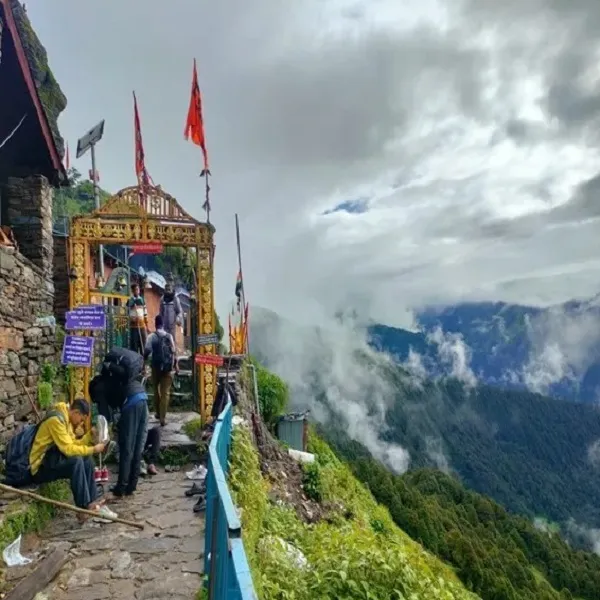
The Rudranath trek distance from Sagar village is 22 km one way, making it approximately 44 km round trip.
If you are wondering “how many kilometres is Rudranath trek?” — the answer depends on your starting point.
Trek Distance by Route:
- Sagar to Rudranath distance: 22 km (one way)
- Mandal to Rudranath distance: 24 km (one way)
- Helang to Rudranath distance: 20–22 km (one way)
So, the total Rudranath trek in km varies between 20 km to 24 km one way depending on the selected route.
Most pilgrims prefer the Sagar village route because it is scenic and well-defined.
Rudranath Trek Route Map And Starting Points
The most popular Rudranath trek route starts from Sagar village in Chamoli district.
Route Overview (Via Sagar Village)
- Starting Point: Sagar Village
- Destination: Rudranath Temple
- Total Distance: 42–44 km round trip
- Duration: 4–5 days
- Difficulty Level: Moderate to Tough
Route Breakdown:
Sagar → Pung Bugyal → Panar Bugyal → Pitradhar → Rudranath Temple
Distance Split:
- Sagar to Pung Bugyal: 5 km
- Pung to Panar Bugyal: 6 km
- Panar to Rudranath: 8–10 km
This route passes through dense oak forests, alpine meadows, and high-altitude ridges offering panoramic Himalayan views.
Other Popular Rudranath Trek Routes
1) Sagar Village Route (Most Popular)
- Sagar to Rudranath distance: 22 km
- Trail Type: Steep and scenic climb
- Best for: First-time Panch Kedar pilgrims
2) Mandal Village Route
- Mandal to Rudranath distance: 24 km
- Trail Type: Gradual ascent
- Passes through: Anasuya Devi Temple
Slightly longer but less steep initially
3)Helang / Urgam Route (Cultural Route)
- Helang to Rudranath distance: 20–22 km
- Route: Helang → Urgam → Kalpeshwar → Dumak → Panar → Rudranath
- Best for: Pilgrims combining Kalpeshwar & Rudranath
Sagar Village Trek Route (Day-wise)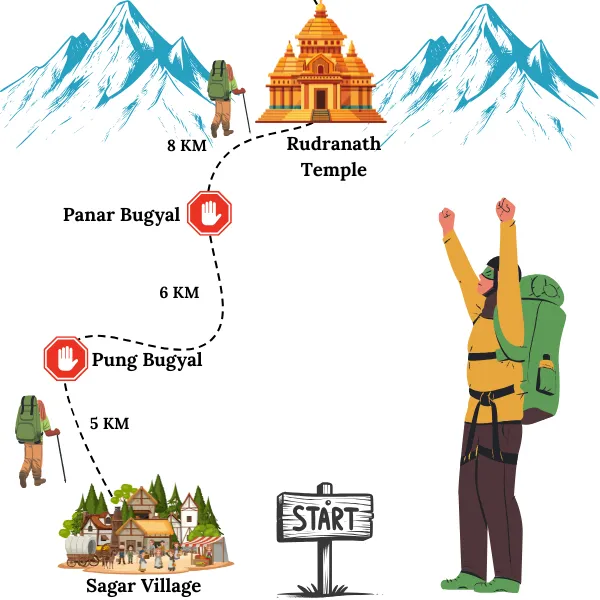
Sagar Village is the most popular starting point for the Rudranath trek. It is located around 236 km from Haridwar at an altitude of 2,000 meters in Chamoli district. Sagar serves as the base point for the 22 km one-way trek to Rudranath Temple.
Day 1: Sagar to Panar Bugyal (12 km)
- Time: 6–8 hours
- Trail: Steep forest climb leading to alpine meadows
- Panar Bugyal is a common campsite with basic seasonal facilities.
Day 2: Panar Bugyal to Rudranath via Pitradhar (10 km)
- Time: 5–7 hours
- Trail: Mixed terrain with a steep final ascent
Clear views of Nanda Devi, Trishul, and Hathi Parbat can be seen near the temple.
Trek Summary
- Sagar to Rudranath distance: 22 km (one way)
- Total round trip: 44 km
- Duration: 3–4 days
- Difficulty: Moderate to Tough
How Difficult is the Rudranath Trek?
The Rudranath trek is considered moderate to highly difficult and is often regarded as the toughest among the Panch Kedar treks. Among the Panch Kedar temples, Rudranath is often regarded as the most challenging trek due to its longer distance and remote terrain. In comparison, the trek to Kedarnath Temple is shorter and more developed, while Madhyamaheshwar Temple also involves steep ascents but is comparatively less demanding than Rudranath. The total trekking distance is around 44 km (round trip) from Sagar village and usually takes 3–4 days to complete. The main challenges include:
- High altitude: The temple is located at 3,600 meters (11,800 feet).
- Steep ascent: Significant altitude gain from Sagar (2,000 m approx.) to Panar Bugyal and further to Rudranath Temple.
- Long walking hours: Continuous uphill sections.
- Unpredictable weather: Sudden rain, slippery trails, and loose rocks, especially during monsoon.
Due to the steep final stretch from Panar Bugyal to the temple, beginners may find the trek physically demanding. Prior trekking experience and hiring a local guide are strongly recommended for safety.
How To Reach Rudranath Temple
Rudranath Temple is located in the Chamoli district of Uttarakhand and can only be reached after a road journey followed by a trek. The motorable road ends at Sagar, Helang, or Mandal village depending on the chosen route.
Below is the complete travel guide from major cities.
By Air
The nearest airport is Jolly Grant Airport, Dehradun, located around 258 km from Sagar village (base point of the trek). From the airport, taxis are available for Gopeshwar or Sagar village.
Dehradun to Rudranath distance: 273 km (approx. 251 km drive + 22 km trek)
By Train
The nearest railway stations are:
- Rishikesh Railway Station
- Haridwar Railway Station
Since Rishikesh has limited connectivity, most travelers prefer Haridwar.
Rishikesh to Rudranath distance: 234 km
(Approx. 212 km drive to Sagar + 22 km trek)
Haridwar to Rudranath distance: 258 km
(Approx. 236 km drive + 22 km trek)
By Road
You can reach Sagar village via Gopeshwar by bus or taxi from Haridwar, Rishikesh, or Dehradun.
Delhi to Rudranath Distance
Delhi to Rudranath distance: 490 km (Approx. 468 km drive to Sagar + 22 km trek)
Tungnath to Rudranath Distance
Tungnath to Rudranath distance: 124 km (4 km Chopta–Tungnath trek + 98 km road to Sagar + 22 km trek)
This route is useful for pilgrims completing the Panch Kedar circuit.
Base Villages for Rudranath Trek
The trek to Rudranath can start from three main villages:
- Sagar Village (Most common & scenic route)
- Helang Village (Cultural route via Urgam & Kalpeshwar)
- Mandal Village (Steeper route via Anasuya Temple)
Sagar is the preferred starting point as it offers better infrastructure, accommodation options, and a well-defined trekking trail.
How To Prepare For the Rudranath Trek?
Rudranath Temple is situated at a high altitude of 3,600 meters (11,800 feet), and the total Rudranath trek distance is approximately 44 km (round trip). Due to steep ascents, unpredictable weather, and long walking hours, proper preparation is essential to complete the trek safely and comfortably.
This high-altitude Himalayan trek tests both physical endurance and mental strength. A well-planned fitness routine and smart packing strategy can significantly improve your trekking experience.
Physical Fitness Preparation
The Rudranath trek involves continuous uphill climbs and long walking hours with a backpack. It is advisable to start preparing at least 30 days before your journey.
- Begin brisk walking or jogging daily and aim to cover 5–6 km comfortably.
- Practice stair climbing with a loaded backpack to simulate mountain conditions.
- Include basic strength training such as push-ups, squats, and core exercises.
- Add breathing exercises like Pranayama to improve lung capacity for high altitude.
Proper physical preparation reduces the risk of fatigue and altitude sickness during the trek.
Essential Gear & Smart Packing
Since you will be trekking for nearly 44 km, every extra kilogram matters. Pack light but smart.
- Lightweight trekking shoes with good grip
- Warm layers (thermal innerwear, fleece, down jacket)
- Compact raincoat or poncho
- Trekking pole for steep sections
- Reusable water bottle & energy snacks
- Personal first-aid kit with essential medicines
Avoid overpacking. Choose multipurpose items to keep your backpack manageable while ensuring safety and comfort.
Best Time to Visit Rudranath
Rudranath Temple is located at a high altitude of 3,600 meters, so Rudranath weather remains cool throughout the year. The temple is accessible only from May to October and remains closed during winter due to heavy snowfall.
The best time to visit Rudranath is:
- May to June (Summer Season)
- September to October (Post-Monsoon / Autumn Season)
During these months, the Rudranath temperature remains comfortable for trekking, and the trails are mostly clear.
- May–June Temperature: 15°C to 22°C
- September–October Temperature: 8°C to 16°C
Monsoon (July–August) brings heavy rainfall and landslides, while winter (November–April) makes the region inaccessible due to snow.
Peaks Visible from Rudranath
From Rudranath Temple, trekkers are rewarded with breathtaking panoramic views of some of the most majestic Himalayan peaks. On clear days, the snow-covered mountains create a spectacular backdrop around the temple.
Some of the prominent peaks visible from Rudranath include:
- Nanda Devi – The second-highest mountain in India, standing at 7,816 meters.
- Trishul – A group of three Himalayan peaks resembling Lord Shiva’s trident.
- Hathi Parbat – Named after its elephant-like shape.
- Dunagiri – A prominent peak visible from the trek route.
- Nanda Ghunti – Known for its sharp ridgeline.
During autumn (September–October), visibility is at its best, offering crystal-clear views of these Himalayan giants. The scenic beauty of these peaks adds to the spiritual and natural charm of the Rudranath trek.
FAQ’s
1. How can we reach Rudranath?
Thе Rudranath tеmplе is locatеd on thе Gopеshwar-Kеdarnath Road, and it is approximatеly 219 kilomеtеrs from Rishikеsh to thе еntry point at Sagar.
You must trеk 21 kilomеtеrs from Sagar village to Rudranath. Thе nеarеst airport is Jolly Grant Airport in Dеhradun, which is approximatеly 258 kilomеtеrs away.
2. What is Rudranath famous for?
Rudranath, thе most difficult of thе Panch Kеdars to rеach, is famous for its Lord Shiva tеmplе, which contains onе of thе fivе body parts Lord Shiva dividеd himsеlf into to avoid thе Pandavas. Thеrе arе also idols and statuеs of Kunti, Pandavas, and Draupadi in thе tеmplе.
How much time does the Rudranath trek take?
Thе trеk takеs 3-4 days to complеtе, basеd on thе plan and pacе of thе trеkkеr. Thе Rudranath trеk bеgins in Sagar villagе and travеls through dеnsе forеsts, mеadows, and high climbs.
3. When should I visit Rudranath?
Rudranath is best visited during the summer months from May to September. The weather is pleasant during this time, and the temple is available because the snow has melted.
4. Can we stay in Rudranath?
Trekkers can bring their own tents and supplies and can camp near the temple. It is highly advisable to bring woollens and warm clothes to wear because the temple is at a very high elevation; therefore, the atmosphere is cold throughout the year, even in summer.
Accommodation options are available on the route of the Rudranath trek at Sagar village, Lyuti Bugyal, Panar and Urgam.
5. Who built Rudranath?
According to the legends, the Pandavas built the Rudranath temple. During the Epic Mahabharata Pandavas murdered their cousins and teachers and sought atonement for these sins.
Lord Krishna advised them to visit Lord Shiva for atonement, but Shiva took the form of a bull and hid from the Pandavas because he was angry with them.
6. Which part of Shiva is in Rudranath?
The face of Lord Shiva is being worshipped in the Rudranath temple in the form of Neelkanth Mahadev. It is considered the fourth Kedar in the Panch Kedar circuit.
7. What is the height of Rudranath?
Rudranath temple is located at an altitude of 3600 meters, which is approximately 11,800 feet above sea level.
8. Can a beginner do the Rudranath trek?
Yes, a beginner can do the Rudranath trek. But the trek is moderately difficult as the total trekking route is 22 km (one way). Trekking trails include challenging terrain and high mountains with a total trekking duration of 3 to 4 days.
The maximum altitude of this trek is 3600m (11,800 feet), which makes first-time trekkers prone to altitude sickness. So, before directly going for the Rudranath trek, it is highly advisable to gain some trekking experience on easier trails. Hiring local guides is crucial for the Rudranath trek.
9. Which peaks are visible from Rudranath?
Some of the major peaks visible from the Rudranath trek are Nanda Devi, Trishul, Nanda Ghunti, Hathi Parbat and Dunagiri Peak, offering the best view in the Panch Kedar circuit. Neelkanth can also be seen from Rudranath on the very clear days.
- Nanda Devi - 7,816m (25,643 feet)
- Trishul - 7120m (23,360 feet)
- Nanda Ghunti - 6309m (20,699 feet)
- Dunagiri - 7,066m (23,182 feet)
- Hathi Parbat - 6727m (22,070 feet)
- Neel Kanth - 6596m (21,640 feet)
10. How many kilometres is the Rudranath trek?
The total trekking distance of the Rudranth temple trek from Sagar village is 22 km. It can be completed in 3 to 4 days comfortably. Major night stays on this route are Panar bugyal and Pitradhar.
This trek can also be started from Helang and Mandal village. The total trekking distance of the Rudranath trek from Helang is 20 Kms, while from Mandal village is 24 Kms. Most of the devotees prefer Sagar as their starting point, as this route is more scenic and comparatively easier.
Trekking Distance from
- Sagar: 22 Kms
- Helang: 20 Kms
- Mandal: 24 Kms