
Panchgavya Controversy 2026: Gangotri Temple Entry Rules Explained
Category: Travel | Updated On: October 14, 2026 | Published: April 29, 2026
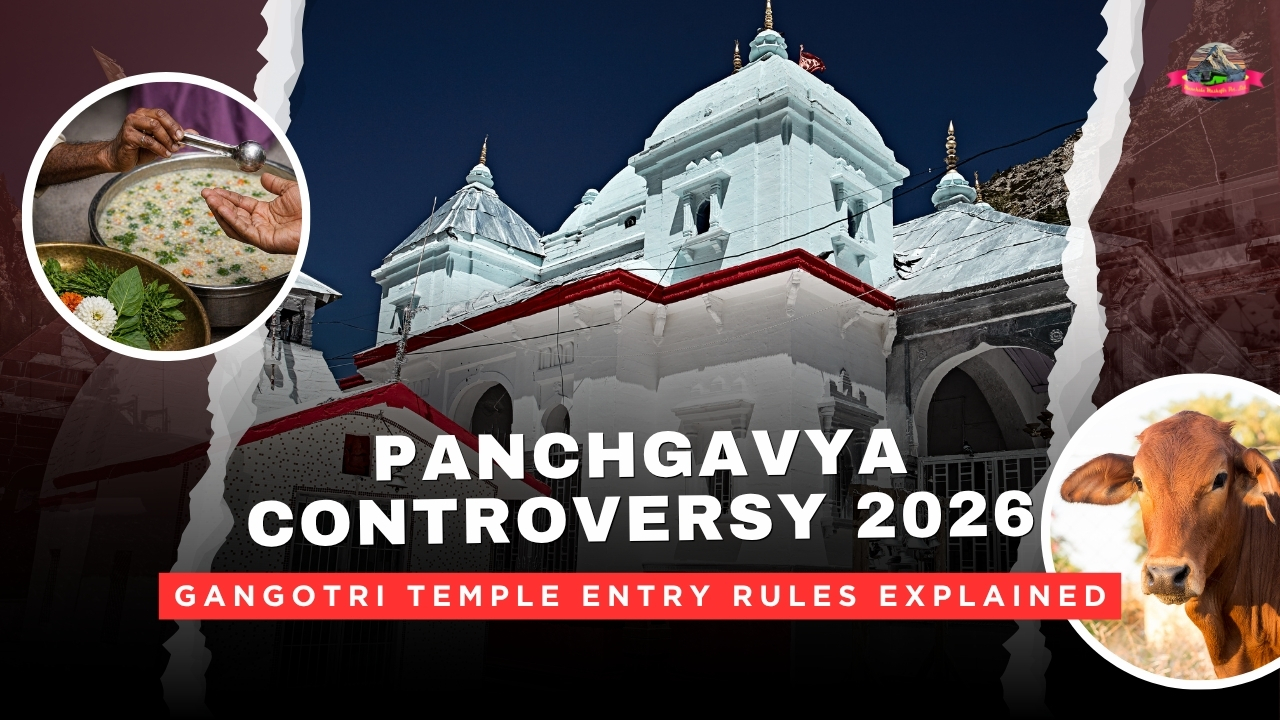
In 2026 the Gangotri temple committee said that non-Sanatani (non-Hindu) visitors must take Panchgavya, a mixture of five cow products, before entering Gangotri temple. Hindu pilgrims, including Sikhs, Jains and Buddhists counted within the Sanatan fold, do not have to. At Badrinath and Kedarnath the rule is different: the Badrinath-Kedarnath Temple Committee (BKTC) asks non-Hindus to sign an affidavit of faith in Sanatan Dharma, with no Panchgavya. Yamunotri has no such condition and welcomes everyone.
Gangotri Temple Entry Rules 2026 at a Glance
| Who | What the rule says |
| Hindu pilgrims (including Sikh, Jain and Buddhist visitors) | Normal entry; no Panchgavya required |
| Non-Sanatani (non-Hindu) visitors | Must take Panchgavya before entering the temple, according to press reports quoting the temple committee |
| All pilgrims | Char Dham registration is mandatory during the yatra season |
The rule was reported when the Gangotri doors opened on 19 April 2026, Akshaya Tritiya (ETV Bharat). Reports quoted committee chairperson Dharmendra Semwal saying the aim was to make sure that only visitors with faith enter the shrine (NewsBytes).
What Is Panchgavya?
Panchgavya (panch = five, gavya = from the cow) is a mixture of five cow products: milk, curd, ghee, cow urine and cow dung, sometimes with Ganga water. In Hindu ritual it is used for purification, in Vedic ceremonies and in some Ayurvedic preparations (Free Press Journal).
The temple committee’s view is that taking Panchgavya is a traditional act of purification before approaching the deity, and that it marks a visitor’s acceptance of the shrine’s faith.
How the Char Dham Temples Compare
| Temple | Managed by | Rule for non-Hindu visitors (2026) |
| Gangotri | Gangotri temple committee | Must take Panchgavya before entry |
| Badrinath and Kedarnath | Badrinath-Kedarnath Temple Committee (BKTC) | Must sign an affidavit of faith in Sanatan Dharma; forms are given at the temple. No Panchgavya |
| Yamunotri | Yamunotri temple committee | No condition; open to all |
The BKTC resolution was passed in March 2026 and covers Badrinath, Kedarnath and the other temples it manages. BKTC chairman Hemant Dwivedi said anyone who declares faith in Sanatan Dharma in the affidavit may have darshan (ETV Bharat).
Why the Rule Is Debated
- Faith and tradition: supporters say temple committees have the right to set rules that protect the sanctity of a shrine.
- Inclusion: critics say making entry depend on a ritual excludes visitors of other faiths who come with respect.
- Health: doctors and travellers have questioned whether consuming cow urine and dung is safe, especially for people with weak immunity or stomach problems.
- Practicality: the temple sees thousands of visitors a day in peak season, which raises questions about queues and hygiene.
Tips for Visiting Gangotri
- Register first: Char Dham registration is free and mandatory; carry your registration and a photo ID.
- Know the rule: if you are not Hindu, expect to be asked to take Panchgavya. If you have a health concern, speak to the temple staff before you queue.
- Check the dates: Gangotri opened on 19 April 2026 and closes on 10 November 2026 at 12:05 PM; see the Gangotri opening and closing date.
- Respect the altitude: the temple is at about 3,100 m (10,200 ft). Drink water, climb gradually and check Gangotri weather today.
- Plan the trip: our Char Dham Yatra package covers Gangotri. Before you go, read the history of Gangotri temple and the places to visit in Gangotri.
Sources
- ETV Bharat: Char Dham Yatra 2026 begins, Gangotri and Yamunotri open (19 April 2026)
- NewsBytes: Gangotri temple requires non-Hindu visitors to drink Panchgavya
- Free Press Journal: What is Panchgavya and why it is linked to Gangotri Dham visits
- ETV Bharat: Non-Sanatanis can have darshan at BKTC-run shrines by submitting an affidavit
This article reports news coverage and does not take a position on the rules. We respect the faith of every pilgrim.
FAQs on the Gangotri Panchgavya Rule
1) What is the new 2026 entry rule at Gangotri temple?
In 2026 the Gangotri temple committee said non-Sanatani (non-Hindu) visitors must take Panchgavya, a mixture of five cow products, before entering the temple. Hindu pilgrims are not required to.
2) Does every pilgrim have to drink Panchgavya at Gangotri?
No. According to press reports, the rule applies only to non-Sanatani (non-Hindu) visitors. Hindu pilgrims, including Sikhs, Jains and Buddhists, enter as usual.
3) What is Panchgavya made of?
Panchgavya is made of five cow products: milk, curd, ghee, cow urine and cow dung, sometimes mixed with Ganga water. It is used in Hindu purification rituals.
4) Do Badrinath and Kedarnath also require Panchgavya?
No. The Badrinath-Kedarnath Temple Committee asks non-Hindu visitors to sign an affidavit of faith in Sanatan Dharma, with forms available at the temple. There is no Panchgavya requirement there.
5) Can non-Hindus visit Yamunotri?
Yes. Yamunotri has not announced any condition for non-Hindu visitors and welcomes all pilgrims.
6) What if I have a health concern about Panchgavya?
Speak to the temple staff before you join the queue and carry any medical documents. Rules and exceptions are set by the temple committee, so confirm on the spot.
7) When does Gangotri temple close in 2026?
Gangotri temple closes on 10 November 2026 at 12:05 PM, on Annakut, the day after Diwali. It is expected to reopen on Akshaya Tritiya, around 8–9 May 2027.