Introduction To Gangotri Temple History
Gangotri Temple is one of the most sacred Hindu pilgrimage sites and a vital part of the Char Dham Yatra in Uttarakhand. The history of Gangotri Temple is deeply rooted in ancient Hindu mythology, spiritual legends, and documented historical accounts dating back to the 18th century. Dedicated to Goddess Ganga, the temple is revered as the spiritual origin of the holy River Ganga, which holds immense significance in Hinduism as a symbol of purity and salvation.
Located in the Uttarkashi district of Uttarakhand, on the banks of the Bhagirathi River at an elevation of around 10,200 feet, Gangotri Dham has been a site of devotion for centuries. According to Hindu beliefs, this is the sacred place where Goddess Ganga descended from heaven to earth after the intense penance of King Bhagirath, making it one of the most spiritually powerful destinations in India.
As a travel professional who has explored the Char Dham routes multiple times and interacted closely with local priests and residents, I have come across various oral histories and traditions that align strongly with Hindu scriptures. In this blog, I will explain the mythological origins, historical construction, architectural features, and spiritual significance of Gangotri Temple, helping you understand why this sacred shrine continues to attract devotees from across the world.
Quick Facts About Gangotri Temple
- Location: Uttarkashi district, Uttarakhand, India
- Built By: Gorkha General Amar Singh Thapa
- Century: 18th century
- Elevation: 10,200 ft (3,100 m)
- River Name: Bhagirathi
- Presiding Deity: Goddess Ganga
- Char Dham Position: Second Dham
- Geographical Features:
Riverside Location: The temple is situated on the right bank of the holy Bhagirath River, which is the headstream of the Ganga River.
Surrounding Attractions: The area features steep, rugged terrain, rocky glaciers, and is surrounded by dense deodar, pine forests, and alpine meadows.
Mythological Origins of Gangotri Dham
Legend of King Bhagirath and the Descent of Ganga
The most prominent legend of Gangotri is associated with King Bhagirath's penance and the descent of Goddess Ganga from heaven to purify the souls of ancestors.
According to mythology, King Bhagirath, an ancestor of Lord Rama, performed intense penance to bring the sacred Ganga from heaven, to absorb the sins of his 60,000 ancestors (sons of King Sagar), who were reduced to ashes by sage Kapila’s Curse.
After being blessed by the devotion of King Bhagirath, Goddess Ganga agreed to descend, but warned that her powerful flow may destroy the earth.
Lord Shiva's role: To prevent the force of the descending Ganga River, King Bhagirath prayed to Lord Shiva. Shiva caught Ganga in his matted hair (jata). Breaking its fall and gently releasing in multiple headstreams.
Bhagirath Shilla: The Meditation Spot
Bhagirath Shilla is a sacred rock near the temple, named after King Bhagirath's penance. Believed to be a spot where the king meditated and prayed.
Today, it holds immense spiritual significance; devotees visit here to perform prayers, leaving flowers and meditation. It is believed that touching this sacred rock brings spiritual purification and divine grace for the visitors.
Goddess Ganga: Hindu Belief
Goddess Ganga, the embodiment of the Ganga River, is revered in Hinduism as a celestial river who descended on earth to purify souls and grant salvation, marking it as the symbol of purification and liberation.
Historical Construction of Gangotri Temple
The historical background of the Gangotri temple is a blend of Vedic mythology and 18th-century Gorkha architecture. Here is an overview of early worship of the holy shrine and formal construction.
Early Worship of Gangotri Before the Temple Era
Before the construction of the temple, Gangotri existed as an open-air pilgrimage site. In ancient times, devotees and priests performed all rituals near the banks of the Bhagirathi River.
A notable feature of Gangotri is the Jalmagna Shivlinga, which is worshipped as the site where Lord Shiva received the Ganga from his matted locks to break her fall. This region also serves as a refuge spot for rishis, who established small ashrams.
Construction of the Temple (18th Century)
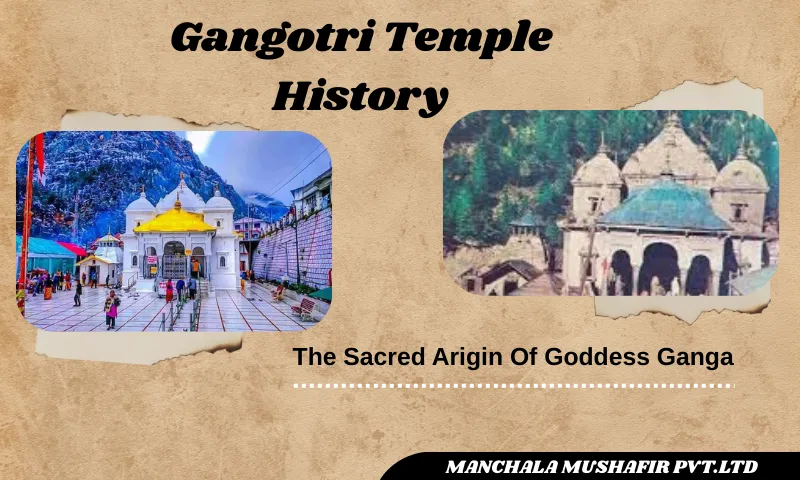
In the early 18th century, the first formal temple was built by Gorkha General Amar Singh Thapa. He constructed this shrine using white granite in a traditional North Indian architecture, marking the spiritual origin of the Ganga River.
Restoration and Royal Patronage
The original temple got damaged by natural avalanches. The temple was restored and rebuilt by Maharaja Madho Singh of Jaipur in the 20th century, ensuring its structural stability in the harsh Himalayan climate.
Architectural Style and Design of Gangotri Temple
The architecture of the Gangotri temple is a unique blend of Nagara and Katyuri architectural styles. The temple was built using gleaming white granite.
Key Architectural Features:
Structure & Height: The temple stands approximately 20 feet tall and is constructed of almost white granite, giving a luminous appearance.
Shikhar: The top shikhar features five small apexes on its roof. It includes three primary golden spires.
Sabha Griha: A small first courtyard, followed by this hall, where they gather for prayers before entering the main sanctum.
Garhbhgriha: The inner sanctum houses a silver idol of Goddess Ganga on a raised platform.
Surroundings: The temple complex houses four smaller shrines dedicated to Lord Shiva, Ganesha, Hanuman, and Bhagirath.
Spiritual Significance of Gangotri in Char Dham Yatra
Gangotri Dham is the second sacred site in the Char Dham Yatra of Uttarakhand, established by the efforts of Adi Shankaracharya in the 8th century. The site is significant as the Ganga River and as a dedicated site for Goddess Ganga.
It is the sacred spot where the holy Ganga first touched the earth, after its descent from heaven. It is highly believed that taking a dip in the holy water of the Bhagirath River cleanses all the sins of the past and grants spiritual salvation for visitors.
As one of the four crucial sites of Chota Char Dham Yatra, which involves Yamunotri, Kedarnath, and Badrinath, along with Gangotri, it offers a divine spiritual connection to one of the most revered deities of Hinduism.
Timeline of Key Events in Gangotri’s History
Here is a well-structured timeline of Gangotri temple history, which helps you to understand.
| Time Period | Event | Key Details |
| Mythological Era | Legend of King Bhagirath | King Bhagirath performed intense penance at Bhagirath Shilla to bring Goddess Ganga to Earth for the salvation of his ancestors. |
| Ancient Period | Early worship | For centuries, before temple construction, sages and devotees worshipped the sacred Bhagirathi River, Bhagirath Shilla, and Jalmagna Shivlinga as divine sites. |
| 18th Century | Temple construction | The first formal stone temple was built by Gorkha General Amar Singh Thapa using white granite in the traditional North Indian architectural style. |
| 19th Century (1803) | Destruction & repair | The Himalayan earthquake of 1803 damaged the temple structure, after which repairs and rebuilding were undertaken. |
| 20th Century | Major restoration | Maharaja Madho Singh of Jaipur restored and strengthened the temple, rebuilding the 20-foot-tall structure with granite blocks. |
| Modern Era | Char Dham significance | Today, Gangotri Temple is managed by the Gangotri Temple Samiti and remains a vital part of the Char Dham Yatra circuit. |
Interesting Facts About Gangotri Temple You Should Know
One of the Highest Ganges Shrines: Gangotri is the highest river temple of Ganga, situated at an elevation of 10,200 feet (3100 meters) above sea level.
Gangotri is not the source: While the worship of Goddess Ganga is centered at the temple, the original physical source of the River Ganga, Gaumukh Glacier, is located just 19 km away and accessible by a challenging Gaumukh-Tapovan trek.
Ganga is called Bhagirathi here: At Gangotri, the river is known as Bhagirathi; it is called Ganga after Devprayag.
The daughter of the village: In the local region, particularly around the Mukhba village area, the deity is considered their Daughter, which is welcomed in winter.
Winter rituals: During the winter period, the temple is closed due to heavy snowfall and harsh weather, and the deity is shifted to its winter residence in Mukhba village. The winter worship rituals are performed in Mukhba temple, near Harsil.
The Akhand Jyoti: During the closing, a sacred lamp burned inside the temple, which continues to burn until the reopening of the shrine.
Only one priest family performs rituals: The rituals of the temple are performed by the Semwal Brahmins, who were the original priests of Gangotri.
Final Thoughts On Gangotri History
Gangotri temple is not just a story of divine folklore; it’s a timeless reminder of devotion, persistence, and divine grace. From King Bhagirath's penance, ancient scriptures to living traditions, Gangotri is a symbol of the eternal bond between humanity and divinity.
Today, thousands of pilgrims visit Gangotri, seeking peace of mind and blessings of Maa Ganga, making it one of the most powerful spiritual destinations in India, a symbol of purification and salvation.
Related Guide |
FAQs On Gangotri Temple History
1. What is the history of the Gangotri temple?
The history of Gangotri temple is a unique blend of ancient mythology and 18th-century historical accounts. One is rooted in the King Bhagirath legend, and the other is associated with the physical temple structure.
2. Who built the Gagotri Temple?
The Gangotri temple was built by the Gorkha General Amar Singh Thapa in the 18th century, and it was rebuilt by the king of Jaipur, Madho Singh second, as the earlier structure was destroyed by natural disasters.
3. How old is the Gangotri temple?
The Gangotri temple is approximately 300 years old, having been constructed in the early 18th century. While the site itself has been a divine site for millennia, serving as a meditation spot for sages and rishis.
4. What is the architecture of the Gangotri temple?
The architecture of the Gangotri Temple is a 20-foot-tall structure of the Nagara style architecture, made with white granite stone slabs. Featuring five small shikharas and three main cupolas with a golden roof.
5. What is the story of Ganga and Bhagirath?
The story of Ganga and King Bhagirath is deeply rooted in Hindu mythology. According to the mythology, the king Bhagirath performed a deep meditation for the descent of the Ganga River on earth to cleanse the sins of his ancestors. Goddess Ganga descended on earth with a powerful force, and Lord Shiva caught the river in his matted hair to break her fall. This story marked devotion, persistence, and liberation (moksha).
6. When was Gangotri established?
In the early 18th century, the Gangotri temple was established by the Gorkhas of Nepal, while the current structure of the temple is a result of timely construction and restoration.
7. What is the main origin of the Ganga River?
The Gangotri Glacier, located just 19km from Gangotri Dham, Uttarakhand, is the main origin of the Ganga River, where it is known as the Bhagirathi River.
8. Why is Gangotri Dham Important?
Gangotri Dham is significantly important as the origin of the Ganga River (the most sacred river in Hinduism) and is a vital part of the Char Dham pilgrimage. It is highly believed to be a site where Goddess Ganga first touched the earth during her descents from heaven, marked as the site of spiritual purification and salvation.